
Apple Butter Market Trends, Size & Growth by 2034
Coverage: By Category (Organic,conventional); Distribution Channel (Hypermarkets and supermarkets,convenience stores,online retail,others), and Geography (North America, Europe, Asia Pacific, and South and Central America)
- Status : Data Released
- Report Code : TIPRE00014039
- Category : Food and Beverages
- No. of Pages : 150
- Available Report Formats :


- Last update date : August 26, 2026


2025 Market Size
US$ 196.14 Mn
Base year value
2034 Forecast
US$ 300.97 Mn
Projected by 2034
CAGR 2026-2034
4.87 %
Growth rate
Addressable Market
US$ 2,255.97 Mn
(2026-2034)
The apple butter market is projected to grow from US$ 196.14 Million in 2025 to US$ 300.97 Million by 2034, registering a CAGR of 4.87% during 2026–2034. Demand is supported by renewed consumer interest in fruit-based spreads, clean-label pantry products, and traditional condiments used across breakfast, bakery, and culinary applications.
North America remains the most established revenue base, supported by high apple availability, mature retail access, and strong household familiarity with apple-based spreads. The apple butter market size in the region benefits from orchard-linked supply chains, private-label activity, online grocery expansion, and rising demand for organic fruit spreads.
Apple Butter Market Assessment and Insights
- North America: Accounted for 36–39% share in 2025 and is projected to grow at a CAGR of 4.4–4.9% during 2026–2034, supported by U.S. apple processing scale and specialty retail visibility.
- U.S.: Represented 78–82% of North America's demand in 2025, with a CAGR of 4.3–4.8% driven by branded spreads, farm-market channels, and household pantry usage.
- Europe: Held 27–30% share in 2025 and is projected to grow at a CAGR of 4.1–4.6%, led by Germany, the UK, France, and traditional fruit preserve consumption.
- Asia Pacific: Held 18–21% share in 2025 and is expected to grow at a CAGR of 5.5–6.1%, led by Japan, China, India, South Korea, and Australia.
- Largest Segment: Conventional apple butter held 70–74% market share in 2025 and is projected to expand at a 4.2–4.7% CAGR due to price accessibility and broad retail listing.
- High Growth Segment: Organic apple butter held 26–30% share in 2025 and is projected to grow at a 6.0–6.6% CAGR as clean-label preferences strengthen.
- Key companies analyzed in detail: Eden Foods, Inc.; Knouse Foods Cooperative, Inc.; SHILOH FARMS; Walden Farms International; White House Foods; The J. M. Smucker Company; Colorado Cherry Company; Specialty Food Association, Inc.; Kauffman’s Fruit Farm; and Konkan Kitchen.
Source: The Insight Partners' analysis based on proprietary research, government publications, company annual reports, investor presentations, industry databases, and expert interviews.
Apple butter production has evolved from small-batch orchard processing into a more standardized packaged-food category. Modern processors use controlled cooking, consistency management, jar and pouch packaging, and broader distribution networks to improve shelf stability while preserving traditional flavor. Apple butter market growth is increasingly linked to better ingredient transparency, regional apple sourcing, and crossover usage in bakery fillings, glazes, sauces, and premium breakfast formats.
In the forecast period, new demand is likely to arise from urban retail, specialty groceries, and exporters selling fruit spreads as premium pantry items. Investments are likely to be made in organic certification, reduced-sugar formulas, flavors, and DTC channels. Compliance issues related to labeling, traceability, and food safety are also expected to impact formulation and supplier decisions.
Apple Butter Market Report Scope
| Report Attribute | Details |
|---|---|
| Market size in 2025 | US$ 196.14 Million |
| Market Size by 2034 | US$ 300.97 Million |
| Global CAGR (2026 - 2034) | 4.87% |
| Historical Data | 2021-2024 |
| Forecast period | 2026-2034 |
Apple Butter Market Analysis
The apple butter market growth outlook reflects a combination of consumer nostalgia and modern clean-label purchasing behavior. This is due to its straightforward ingredient list, creamy consistency, and applicability to breakfast, baking, snacking, and foodservice products. High availability of apples in the U.S. is a good foundation for the consistent production process, and increased sales via the Internet help regional companies find more buyers outside the local produce market.
The supply factors include apple harvest quantity, availability of specific grades of fruits, labor prices, and packaging costs. Producers having connections with orchards or cooperation with farmers can better control the quality and volatility of the inputs. On the other hand, premium marketing involves flavor uniformity, clear labeling, organic products, and characteristics of small batches differentiating apple butter from jams, jellies, and applesauce.
Apple butter market analysis shows a mixed competitive structure. Larger food companies and cooperatives use scale, retail relationships, and brand recognition, while smaller producers compete on authenticity, regional identity, and ingredient simplicity. Knouse Foods Cooperative, Inc. and The J. M. Smucker Company remain important in apple-based categories, while Eden Foods, Inc., SHILOH FARMS, and Kauffman’s Fruit Farm support niche and specialty demand.
Investment competition will move away from capacity building towards packaging, web sales presence, and premium positioning. Assortment management, shelf management, and collaboration between the categories and bakeries, breakfasts, and specialty stores will be favored by the companies. Walden Farms International and White House Foods will benefit from more diversified packaged food ranges and fruit processing.
● REPORT CUSTOMIZATION
Tailor This Report To Align With Your Specific Business Requirements
This report can be customized to align precisely with your business objectives, scope, and target markets. Customization options include tailored segmentation, geography, competitive analysis, and strategic insights to support informed decision-making.
Customize This Report →WHAT YOU CAN ADJUST
- ● Segmentations
- ● Geography
- ● Competitive Analysis
- ● Language Preferences
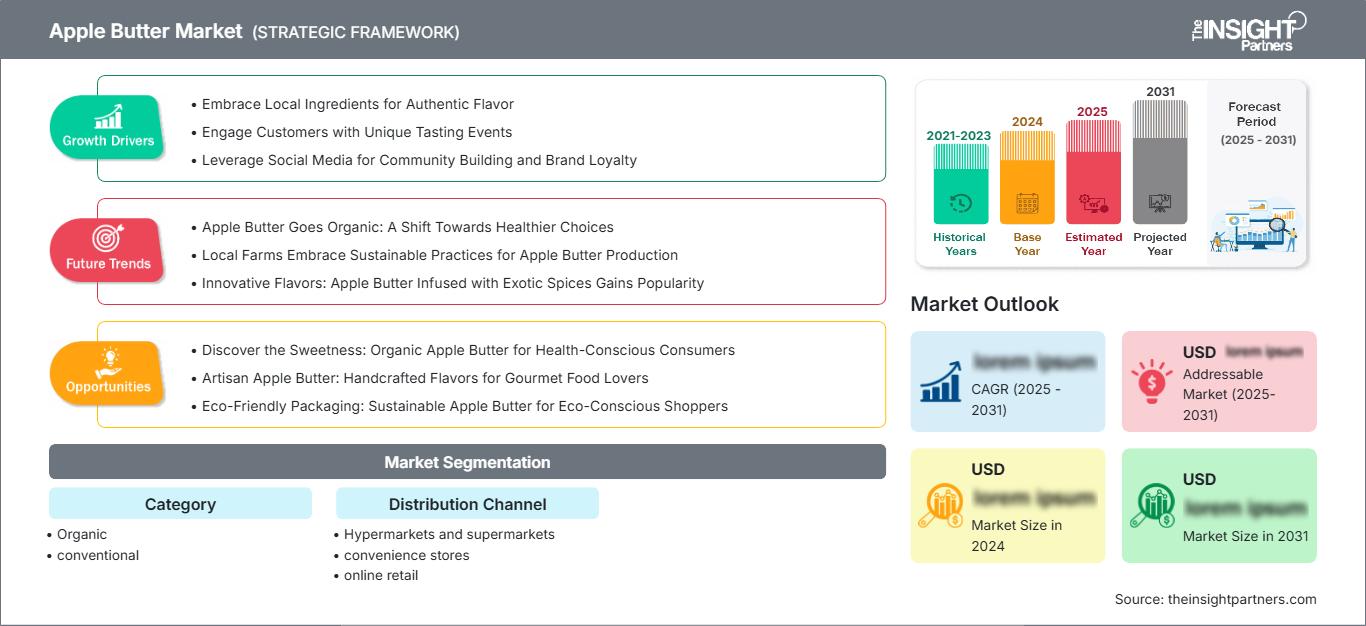
Apple Butter Market: Strategic Insights
Regional Insights
North America Apple Butter Market
North America accounted for 36–39% of the global apple butter market revenue in 2025 and is projected to grow at a CAGR of 4.4–4.9% during 2026–2034. The apple butter market share in the region is supported by high household awareness, farm-market heritage, strong retail access, and a concentrated apple-processing base. The United States will serve as the demand base for the market, and Canada is making its contribution via specialty grocery stores and natural foods. Growth in regional areas is supported by large harvests of apples, seasonal gifts, branding of orchards, and consumers' interest in authentic spreads made from recognizable ingredients. Furthermore, increasing consumer demands for clean label, artisanal preserves, and local foods have further enhanced category performance. Increased distribution of products through supermarkets, farmers' markets, and online channels has helped increase consumer engagement.
U.S. Apple Butter Market
The U.S. represented 78–82% of North America's demand in 2025 and is projected to grow at a CAGR of 4.3–4.8%. According to the Apple Butter Market report, its leadership reflects strong apple production, established processed-fruit manufacturing, and retailer acceptance across conventional, specialty, and online channels. U.S. demand is influenced by breakfast consumption, baking usage, private-label shelf space, and Orchard-branded seasonal marketing. Company presence from cooperatives, national food brands, and regional producers helps maintain broad availability across price tiers. Growing consumer interest in natural ingredients and reduced-artificial-additive products is further supporting market demand. Product innovation, including organic varieties, flavored formulations, and premium packaging, is helping manufacturers attract new customer segments and maintain category relevance.
Europe Apple Butter Market
Europe held 27–30% share in 2025 and is projected to grow at a CAGR of 4.1–4.6%. According to the Apple Butter Market forecast, Germany and the UK lead demand because fruit preserves and breakfast spreads are embedded in household consumption, while France, Italy, and Spain support premium and culinary usage. European market growth comes from the need for fruit-based sauces which have good ingredient lists, medium sweetness and regional origin. European companies that want to cater to this region will need to pay attention to labeling issues, sustainability issues, and competition that exists in terms of already established jams, compotes and fruit butters. Also, consumers' interest in handcrafted foods and recipes provides new opportunities.
APAC Apple Butter Market
APAC held 18–21% share of the apple butter market in 2025 and is projected to grow at a CAGR of 5.5–6.1%. Markets include China, Japan, South Korea, India, and Australia, with consumption driven by modern retail stores, premium imported goods, and use in bakeries. The strongest growth opportunities are where there is interest in developing Western breakfast habits and formats. Localized adaptation, smaller jar sizes, online sales channels, and foodservice partnerships will become increasingly necessary due to less awareness compared to North America and Europe. Urbanization, disposable income, and exposure to international food products are driving consumption growth.
Middle East & Africa Apple Butter Market
The Middle East & Africa apple butter market is projected to grow at a CAGR of 4.6–5.2% during 2026–2034. The Saudi Arabia, UAE, and South Africa markets have the highest demand for this product through the premium grocery channels, hotel food service channels, and specialty food import channels. Market development will be based on the distribution networks, shelf-stable package design, and positioning of apple butter as a premium spread or bakery ingredient. The process of growth will be slow due to a lack of consumer awareness, but there are specific marketing avenues available in the hospitality and expatriate retail channels. In addition, increased tourism and premium food retail developments are increasing international fruit-based food exposure.
Segmentation Analysis
Category
Category segmentation defines the apple butter market scope by organic and conventional positioning. The category is projected to grow at a CAGR of 4.7–5.2% during 2026–2034 as consumers balance affordability, clean-label preferences, and product availability across mainstream and specialty channels.
- Organic: Organic apple butter appeals to shoppers seeking pesticide-conscious sourcing, simple recipes, and premium pantry products. Demand is strongest in natural-food stores, online retail, and urban specialty grocery channels.
- Conventional: Conventional apple butter remains the volume leader because it offers lower pricing, wider availability, and consistent supply. It performs well in supermarkets, mass retail, and foodservice applications.
Distribution Channel
Distribution Channel segmentation is projected to grow at a CAGR of 4.8–5.3% during 2026–2034, reflecting broader retail access and stronger digital discovery. Hypermarkets and supermarkets provide scale, while online retail supports specialty producers and regional brands.
- Hypermarkets and supermarkets: These outlets generate the highest contribution because they combine visibility, private-label opportunities, and routine grocery basket inclusion for breakfast spreads and baking ingredients.
- Convenience stores: Convenience stores remain a smaller route, mainly serving local, seasonal, or impulse purchases where compact formats and regional assortments are available.
- Online retail: Online retail is expanding quickly as specialty brands use digital platforms to reach consumers seeking organic, artisanal, reduced-sugar, or regional apple butter varieties.
Opportunity Snapshot
| Category | Revenue Contribution | Trend Tag | Adoption Stage |
| Organic | Medium | Clean Label | Scaling |
| Conventional | High | Value Retail | Mature |
Apple Butter Market Growth Drivers and Impact Analysis
Clean-label demand strengthens premium fruit spread positioning
There is an increasing trend for consumers to check ingredients in products and look for spreads that are made from fruits and are familiar, natural, and versatile in nature. Apple butter capitalizes on this trend as it can be positioned based on its ingredients, flavor, cooking process, and no addition of dairy in spite of its name. The organic and low-sugar varieties are more appealing to health-conscious families.
Apple supply availability supports processing economics
Apple butter manufacturers can process apples that meet their processing requirements, which may not be the best for display purposes. This is a strategy that will increase efficiency in supply, reduce waste, and maximize returns to growers and co-operatives. Nonetheless, labor prices, variable weather conditions, and package costs are still important factors. Those companies with diverse sources of supply and long-term orchard contacts stand a better chance of ensuring quality and price stability.
Retail and digital channels expand specialty brand reach
The future is becoming increasingly bright for smaller apple butter brands due to the ability to move away from having a strong presence within large grocery stores. Online grocery stores and direct selling through the internet help small brands reach their customers without needing shelf space at a national level. Smaller brands now have the ability to sell specialty items such as limited editions or multipacks through digital platforms. While supermarket shelf space is still necessary for volume, online grocery stores help with both discovery and repurchasing.
Apple Butter Market Future Trends
Organic and reduced-sugar formulations move mainstream
Apple butter market trends indicate that organic, no-sugar-added, and lower-sugar formulations will move from niche shelves toward broader retail acceptance. Consumers want indulgent flavor but are increasingly cautious about added sugars and artificial ingredients. Brands that preserve caramelized apple flavor while improving nutrition positioning can win premium space. This trend will encourage reformulation, clearer front-label claims, and pairing suggestions with yogurt, oatmeal, bakery products, and savory recipes.
Flavor innovation broadens culinary use cases
It seems that apple butter will go far beyond its application on toast and biscuits into sauces, marinades, dessert uses, and accompaniments for charcuterie. Flavor variants such as cinnamon, maple, bourbon-inspired flavors, spicy, vanilla, and regional apples can create distinction. Versatility will be important, given the growing consumer desire for versatility from pantry foods. This will be good news for brands offering recipes, chef collaborations, and packaging options for domestic and commercial kitchens.
Apple Butter Market Opportunities
Premium orchard-linked branding can lift margins
Apple butter forecasts point to stronger opportunities for producers that connect finished products to orchards, growing regions, and harvest authenticity. Consumers often associate fruit spreads with locality and craft, creating room for premium positioning when sourcing claims are credible. Orchard-linked branding can support gifting, tourism retail, subscription boxes, and farm-market extensions. The opportunity is strongest for businesses able to combine storytelling with consistent food safety, scalable production, attractive packaging, and reliable year-round availability. Additionally, growing consumer preference for traceable food products and authentic regional offerings creates favorable conditions for premium product differentiation. Producers that effectively communicate heritage, sustainability practices, and ingredient quality can strengthen customer loyalty, command higher price points, and expand distribution across specialty retail and direct-to-consumer channels.
Foodservice and bakery partnerships create incremental demand
Foodservice partnerships offer an opportunity to expand apple butter beyond household jars. Bakeries, cafés, hotels, and quick-service concepts can use it in pastries, glazes, breakfast sandwiches, desserts, and seasonal menu items. These applications create recurring bulk demand and introduce consumers to new uses. Producers that offer foodservice packs, recipe support, stable texture, and predictable supply can gain incremental revenue while improving consumer awareness through prepared-food channels. Furthermore, collaboration with foodservice operators can encourage menu innovation and support year-round product utilization beyond traditional breakfast applications. As hospitality businesses seek distinctive flavor profiles and premium ingredients, apple butter can serve as a versatile component that enhances both sweet and savory offerings while expanding market visibility.
Frequently Asked Questions

- Comprehensive Market Sizing and Forecast Analysis
- Detailed Segmentation Analysis
- In-Depth Market Dynamics Assessment
- Regional and Country-Level Insights
- Competitive Landscape and Company Benchmarking
- Strategic Business Intelligence
Recent Reports
Testimonials

The Insight Partners provided valuable market intelligence that supported our global go-to-market strategy. Their team was professional, responsive, and attentive to our feedback, providing thoughtful analysis and helpful methodological clarifications throughout the project.
Junmo Kim Chief Financial Officer (CFO), Enertech Co., Ltd.
The Insight Partners' SCADA System Market report is comprehensive, with valuable insights on current trends and future forecasts. The team was highly professional, responsive, and supportive throughout. We are very satisfied and highly recommend their services.
RAN KEDEM Partner, Reali Technologies LTDs
I requested a report on a very specific software market and the team produced the report in a few days. The information was very relevant and well presented. I then requested some changes and additions to the report. The team was again very responsive and I got the final report in less than a week.
JEAN-HERVE JENN Chairman, Future Analytica
We worked with The Insight Partners for an important market study and forecast. They gave us clear insights into opportunities and risks, which helped shape our plans. Their research was easy to use and based on solid data. It helped us make smart, confident decisions. We highly recommend them.
PIYUSH NAGPAL Sr. Vice President, High Beam Global
The Insight Partners delivered insightful, well-structured market research with strong domain expertise. Their team was professional and responsive throughout. The user-friendly website made accessing industry reports seamless. We highly recommend them for reliable, high-quality research services
YUKIHIKO ADACHI CEO, Deep Blue, LLC.
This is the first time I have purchased a market report from The Insight Partners.While I was unsure at first, I visited their web site and felt more comfortable to take the risk and purchase a market report.I am completely satisfied with the quality of the report and customer service. I had several questions and comments with the initial report, but after a couple of dialogs over email with their analyst I believe I have a report that I can use as input to our strategic planning process.Thank you so much for taking the extra time and making this a positive experience.I will definitely recommend your service to others and you will be my first call when we need further market data.
JOHN SUZUKI President and Chief Executive Officer, Board Director, BK Technologies
I wish to appreciate your support and the professionalism you displayed in the course of attending to my request for information regarding to infectious disease IVD market in Nigeria. I appreciate your patience, your guidance, and the fact that you were willing to offer a discount, which eventually made it possible for us to close a deal. I look forward to engaging The Insight Partners in the future, all thanks to the impression you have created in me as a result of this first encounter.
DR CHIJIOKE ONYIA MANAGING DIRECTOR, PineCrest Healthcare Ltd.Reason to Buy
- Informed Decision-Making
- Understanding Market Dynamics
- Competitive Analysis
- Identifying Emerging Markets
- Customer Insights
- Market Forecasts
- Risk Mitigation
- Boosting Operational Efficiency
- Strategic Planning
- Investment Justification
- Tracking Industry Innovations
- Aligning with Regulatory Trends





 Get Free Sample for