
Augmented Reality And Virtual Reality Market Dynamics by 2034
Coverage: By Technology (Augmented Reality and Virtual Reality), Component (Semiconductor Components, Sensors, and Others), and End-User Industry (Entertainment, Educational, Industrial, Medical, Real Estate & Architecture, Retail, Aerospace & Defense, and Others), and Geography
- Status : Data Released
- Report Code : TIPTE100000114
- Category : Electronics and Semiconductor
- No. of Pages : 150
- Available Report Formats :


- Last update date : July 17, 2026


2025 Market Size
US$ 98.21 Bn
Base year value
2034 Forecast
US$ 1658.71 Bn
Projected by 2034
CAGR 2026-2034
36.9 %
Growth rate
Addressable Market
US$ 5,789.73 Bn
(2026-2034)
The Augmented and Virtual Reality Market is valued at US$ 98.21 billion in 2025 and is projected to reach US$ 1658.71 billion by 2034, registering a CAGR of 36.9% from 2026 to 2034. The Augmented and Virtual Reality market reflects accelerating adoption of immersive visualization, spatial computing, AI-enabled interaction, and simulation-based environments across entertainment, education, industrial operations, medical workflows, real estate, retail, and defense applications.
North America remains a priority commercialization base as enterprise pilots move into scaled deployments across training, logistics, digital design, and connected healthcare. The Augmented and Virtual Reality Market size in the region is estimated to expand at a 34.0–37.0% CAGR during 2026–2034, supported by cloud infrastructure, high headset replacement cycles, defense simulation budgets, and growing use of immersive tools in field-service productivity programs.
Augmented Reality and Virtual Reality Market Assessment and Insights
- North America: North America held a 35–39% share in 2025 and is growing at a 34.0–37.0% CAGR between 2026–2034, supported by enterprise training, defense simulation, digital health, and strong platform investment.
- US: The US represented 78–82% of North America in 2025 and is growing at a 33.5–36.5% CAGR between 2026–2034, led by hyperscale, medical, and defense use cases.
- Europe: Europe accounted for a 24–28% share in 2025 and is growing at a 32.0–35.0% CAGR between 2026–2034, with Germany, the UK, France, Italy, and Spain leading industrial and creative adoption.
- Asia Pacific: Asia Pacific held a 28–32% share in 2025 and is growing at a 38.5–42.0% CAGR between 2026–2034, driven by China, Japan, South Korea, India, and Australia across gaming, manufacturing, and education.
- Largest Segment: Solution-led with a 54–58% Augmented and Virtual Reality Market share in 2025 and a 35.0–38.0% CAGR between 2026–2034 as platforms, content engines, and device software captured recurring enterprise budgets.
- High Growth Segment: Medical held an 8–11% market share in 2025 and is growing at a 41.0–45.0% CAGR between 2026–2034 as simulation, rehabilitation, and surgical planning gain acceptance.
- Key companies analyzed in detail: Immersive Gaze Private Limited, Google LLC, EON Reality, Inc., Vuzix Corporation, Blippar Group Limited (Layar B.V.), Innovega Inc., imulanis Solutions Private Limited, Kanda Software, Inc., Meta Platforms Technologies, LLC, Microsoft Corporation, Sony Group Corporation, HTC Corporation, and Magic Leap, Inc.
Source: The Insight Partners' analysis based on proprietary research, government publications, company annual reports, investor presentations, industry databases, and expert interviews.
Immersive technology has moved from entertainment-led experimentation toward operational deployment in design reviews, operator training, product visualization, and remote expert assistance. Hardware production is shifting toward lighter optical systems, improved sensors, and AI-ready chipsets, while software vendors are prioritizing interoperable content pipelines. Device economics are also improving as smart glasses, mixed reality headsets, and mobile AR tools move into defined workflows rather than isolated demonstrations.
Future demand will be shaped by Asia Pacific manufacturing scale, North American platform depth, and European industrial digitization priorities. IMF projections of moderate global growth reinforce the need for productivity-enhancing tools, while WHO health workforce gaps and IATA’s mobile-first passenger data strengthen the case for simulation, remote guidance, and contextual visualization. Public digital-infrastructure programs are expected to support enterprise-grade adoption.
Augmented Reality and Virtual Reality Market Report Scope
| Report Attribute | Details |
|---|---|
| Market size in 2025 | US$ 98.21 Billion |
| Market Size by 2034 | US$ 1658.71 Billion |
| Global CAGR (2026 - 2034) | 36.9% |
| Historical Data | 2021-2024 |
| Forecast period | 2026-2034 |
Augmented Reality and Virtual Reality Market Analysis
Augmented and Virtual Reality Market growth is being driven by enterprises that need faster training cycles, lower travel exposure, and better visualization of complex assets. Entertainment still creates consumer visibility, but industrial, medical, educational, and defense buyers are converting pilots into structured procurement when immersive tools reduce errors, improve knowledge retention, or shorten product-development loops.
The value chain links semiconductor components, sensors, display optics, headset assembly, software engines, content studios, cloud services, and deployment integrators. Supply dynamics are improving as consumer electronics suppliers adapt components for spatial computing; however, optical waveguides, low-latency rendering, battery efficiency, and device comfort remain critical bottlenecks for all-day use.
Augmented and Virtual Reality Market analysis indicates competition between ecosystem owners, hardware specialists, and vertical solution providers. Google LLC, Meta Platforms Technologies, LLC, Microsoft Corporation, Sony Group Corporation, HTC Corporation, and Magic Leap, Inc. shape platform direction, while Vuzix Corporation, EON Reality, Inc., Immersive Gaze Private Limited, imulanis Solutions Private Limited, and Kanda Software, Inc. address enterprise, learning, and services-led deployment needs.
Investment is concentrating on AI assistants, developer tools, spatial content libraries, lighter displays, eye tracking, and enterprise security. Blippar Group Limited (Layar B.V.) and Innovega Inc. strengthen specialist positioning around AR content and wearable optics. Suppliers that combine validated use-case templates with integration support should be better placed than firms relying only on hardware refresh cycles.
● REPORT CUSTOMIZATION
Tailor This Report To Align With Your Specific Business Requirements
This report can be customized to align precisely with your business objectives, scope, and target markets. Customization options include tailored segmentation, geography, competitive analysis, and strategic insights to support informed decision-making.
Customize This Report →WHAT YOU CAN ADJUST
- ● Segmentations
- ● Geography
- ● Competitive Analysis
- ● Language Preferences
Augmented Reality and Virtual Reality Market: Strategic Insights
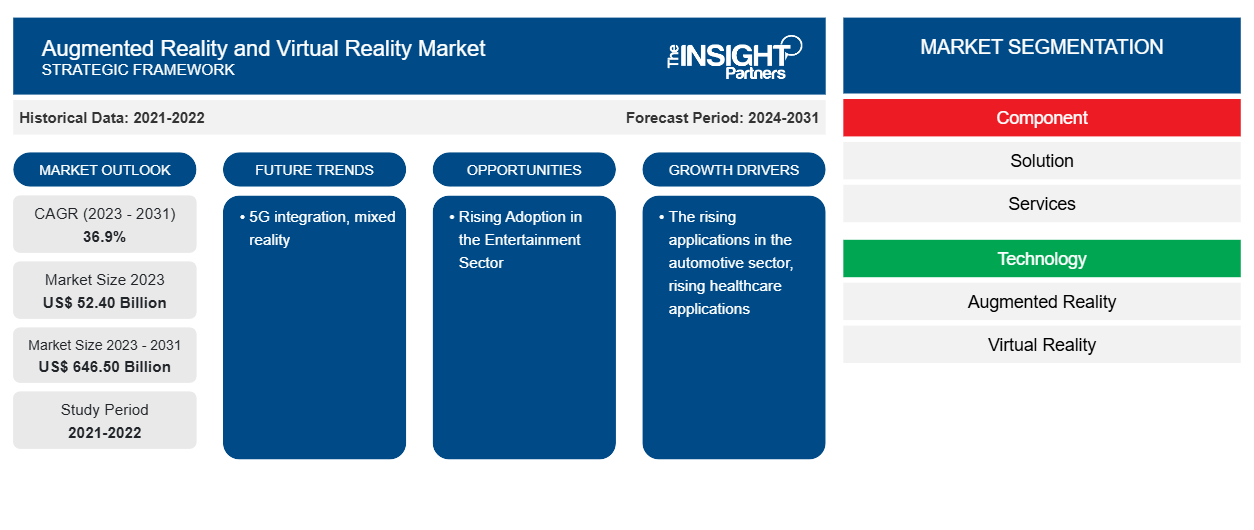
Regional Insights
North America Augmented and Virtual Reality Market
North America accounted for a 35–39% share in 2025 and is expected to grow at a 34.0–37.0% CAGR during 2026–2034. The Augmented and Virtual Reality Market share in the region is supported by defense simulation, digital twin adoption, medical training, and large software ecosystems that accelerate application development.
Enterprise demand is strongest in field service, logistics, aviation training, retail visualization, and engineering collaboration. IATA’s 2025 passenger data points to higher mobile and biometric expectations, encouraging airports and airlines to test immersive assistance. Healthcare providers also use simulation to offset clinical training pressure, while cloud providers reduce deployment friction through spatial computing toolkits.
U.S. Augmented and Virtual Reality Market
The US represented 78–82% of North America in 2025 and is growing at a 33.5–36.5% CAGR during 2026–2034. The demand would be driven by defense modernization, AI infrastructure, digital health investments, and large enterprise software buyers who could enable pilots of multi-site projects in training, maintenance, and product design.
The market participants are diverse. On the one hand, Google LLC and Meta Platforms Technologies, LLC operate in operating systems and developer platforms, while, on the other hand, Microsoft Corporation, Vuzix Corporation, Magic Leap, Inc., and EON Reality, Inc. focus on enterprise and training applications. The applications are transitioning from independent headsets to AI-enabled workflows, spatial content, and remote collaboration.
Europe Augmented and Virtual Reality Market
Europe held a 24–28% share in 2025 and is expected to grow at a 32.0–35.0% CAGR during 2026–2034. Germany is the leading country because automotive engineering, industrial automation, and advanced manufacturing create strong demand for digital twins, shop-floor guidance, and design visualization. The UK is advancing training, creative content, and defense simulation through a strong gaming and software base.
France supports aerospace, healthcare, and luxury retail experience solutions, whereas Italy and Spain are looking to expand their industrial visualization, architecture, tourism, and educational application scenarios. The adoption of these technologies in Europe is influenced by considerations related to privacy and workplace safety laws. Preferred vendors will be those who can provide localization, content management, and integration features.
APAC Augmented and Virtual Reality Market
APAC accounted for 28-32% in 2025 and is forecast to grow at a CAGR of 38.5-42.0% between 2026 and 2034. China leads in the region in volume terms in gaming, e-commerce, manufacturing, and device logistics, while Japan and South Korea provide high-end hardware, automotive visualization, and electronics.
India is increasing the production of enterprise training, educational, and start-up content through its digital public infrastructure and cheaper devices. Australia brings mining, healthcare, and defense training applications into the picture. There will be policy incentives for electronics manufacturing, 5G deployment, and AI-based productivity tools.
Middle East & Africa Augmented and Virtual Reality Market
Middle East & Africa is expected to grow at a 31.0–34.5% CAGR during 2026–2034. Saudi Arabia is the largest regional user, with smart-city initiatives, energy-sector training, defense simulations, and cultural destinations. The UAE drives the adoption of immersive technologies in retail, aviation, tourism, and government services, while South Africa invests in applications in mining, healthcare, and education.
The use of immersive technology by energy firms and infrastructure managers helps reduce the number of site visits, speed up safety training, and enable remote diagnostics. Different rates of technology adoption are driven by equipment costs, connectivity requirements, and a lack of local content. Vendors that work with systems integration firms and training companies can help solve procurement difficulties.
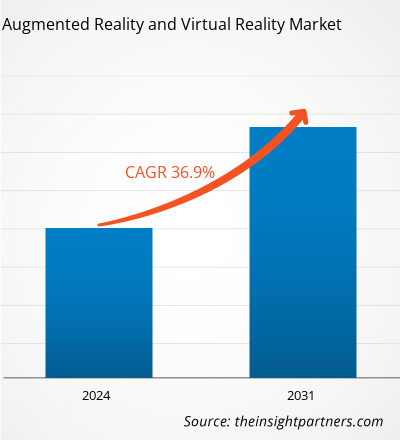
Segmentation Analysis
Component
The Component segment covering solutions and services is estimated to grow at a 35.0–38.0% CAGR during 2026–2034. Augmented and Virtual Reality Market scope across this segment is widening as software platforms, content libraries, deployment services, managed support, and integration programs become essential for enterprise adoption beyond standalone device procurement.
- Solution: Solutions hold the strongest revenue position because immersive platforms, development tools, content engines, and device management systems create scalable deployments across training, visualization, collaboration, and customer engagement use cases.
- Services: Services remain strategically important as enterprises need content creation, workflow integration, user training, change management, cybersecurity alignment, and analytics support to convert pilot programs into repeatable operations.
Technology
The Technology segment is projected to grow at a 36.0–39.0% CAGR during 2026–2034 as augmented overlays and fully immersive environments serve different operational goals. Augmented reality supports contextual assistance and visualization in live settings, while virtual reality delivers controlled simulation, risk-free practice, and repeatable training for complex procedures.
- Augmented Reality: Augmented reality adoption is strongest where users need hands-free instructions, contextual data overlays, remote expert support, or customer visualization without leaving the physical operating environment.
- Virtual Reality: Virtual reality remains central for gaming, simulation, education, and medical training because it provides repeatable environments where users can practice hazardous or costly tasks safely.
Component
The Component segment covering semiconductor components and sensors is expected to grow at a 34.5–38.5% CAGR during 2026–2034. Demand depends on low-power processors, cameras, inertial measurement units, depth sensors, eye tracking, display drivers, and connectivity chips that determine comfort, latency, tracking precision, and battery performance.
- Semiconductor Components: Semiconductor components are strategically important because processing efficiency, display control, wireless connectivity, and thermal behavior directly affect headset weight, rendering quality, and enterprise reliability.
- Sensors: Sensors support spatial mapping, hand tracking, gaze interaction, motion detection, and environmental awareness, making them essential for natural interaction and safer use in industrial, medical, and retail settings.
End-User Industry
The End-User Industry segment is forecast to grow at a 36.5–40.0% CAGR during 2026–2034, owing to adoption not just for consumer experiences but for measurable efficiency gains. Consumers prefer platforms that can demonstrate cost reductions in training and engagement, fewer operational mistakes, quicker design approvals, or better customer conversions.
- Entertainment: Entertainment continues to be an important area of adoption, supported by gaming, location-based experiences, immersive media, and social interactions that foster familiarity with devices and content.
- Educational: Educational institutions use immersive modules for science, technical skills, language learning, and vocational practice, especially where visual context and repeatable simulations improve engagement and retention.
- Industrial: Industrial users deploy immersive tools for maintenance, assembly guidance, quality checks, safety drills, and digital twin visualization, with demand tied to measurable productivity and downtime reduction.
- Medical: Medical use cases are expanding in surgical planning, anatomy education, therapy, rehabilitation, and clinician training as providers seek scalable methods to address skill shortages and procedural complexity.
- Real Estate & Architecture: Real estate and architecture users rely on immersive walkthroughs, design collaboration, spatial planning, and client visualization to improve decision-making before construction or property investment.
- Retail: Retail adoption focuses on virtual try-on, product visualization, store planning, and assisted selling, helping brands improve customer confidence while reducing returns and merchandising uncertainty.
- Aerospace & Defense: Aerospace and defense users invest in immersive mission rehearsal, maintenance training, cockpit familiarization, and situational awareness tools where safety, readiness, and cost avoidance are critical.
Opportunity Snapshot
| End User Industry | Revenue Contribution | Trend Tag | Adoption Stage |
| Entertainment | High | Social Gaming | Mature |
| Educational | Medium | Skills Labs | Scaling |
| Industrial | High | Digital Twins | Scaling |
| Medical | Medium | Surgical Simulation | Emerging |
| Real Estate & Architecture | Medium | Virtual Walkthrough | Scaling |
| Retail | Medium | Virtual Try-on | Scaling |
| Aerospace & Defense | High | Mission Training | Mature |
Augmented Reality and Virtual Reality Market Growth Drivers and Impact Analysis
Enterprise Training Moves from Pilot to Measured Deployment
Companies have turned to immersive training whenever repetition of the process lowers safety risks, travel expenses, or time to competency. Simulation training is being used across manufacturing, aviation, healthcare, energy, and defense organizations to replicate training processes that would otherwise be costly or risky to conduct in person. The need for scalable healthcare training is driven by the WHO's projection of an 11-million-health-professional shortage by 2030. Meanwhile, manufacturers will have to contend with the retirement of specialists and distributed operations. Adoption of immersive training will manifest in stricter buying practices, in which analytics, completion rates, and productivity results must be demonstrated before scaling.
Spatial Computing Becomes Part of Digital Transformation
Digital transformation programs are expanding beyond dashboards and automation to spatial interfaces that help workers interpret data within the operating environment. Shopping centers leverage 3D visualization to minimize uncertainty in purchase decisions, architects bring stakeholders together through virtual tours, and manufacturing plants incorporate instructions onto machinery to aid maintenance. The value proposition gains strength when immersive tools are integrated into product lifecycle management, enterprise resource planning, and customer relationship management systems. This value proposition changes purchasing behavior by integrating the technology into workflow architecture. Integrators and software vendors that understand enterprise data models are therefore positioned to capture implementation and support revenue.
AI, 5G, and Sensor Fusion Improve Use-Case Quality
The quality of use cases increases due to better AI assistants, higher connectivity, spatial mapping, and multimodal sensors that ease implementation. AI assistants can be used for summarizing commands, object detection, language translation, and personalized learning paths; fast connectivity enables the delivery of rendered material from the cloud and enables collaboration. Sensor fusion improves hand tracking, environmental awareness, and gaze interaction, making the experience more natural. In turn, this will enable addressing a wider pool of buyers who do not require specialist technology knowledge, such as field technicians, retail employees, students, and clinicians.
Augmented Reality and Virtual Reality Market Future Trends
AI-Native Smart Glasses and Contextual Assistants
Augmented and Virtual Reality Market trends are shifting toward AI-native smart glasses that can understand context, listen to voice commands, and provide lightweight assistance without isolating users from the physical world. This direction will lead to preference towards smaller screens, better batteries, on-device processing, privacy icons, and seamless phone interaction. The enterprise will prefer features such as task assistance, language translations, inspection, and information gathering over full immersion. As the Android-like XR ecosystem matures, developer involvement will grow, leading to more vertical apps and higher interoperability expectations.
Digital Twins Become Collaborative Operating Environments
Digital Twins will move from being engineering visualization tools to becoming collaboration spaces for planning, maintenance, safety inspections, and operations decision-making. Manufacturing plants, airports, hospitals, energy centers, and military bases can use sensor data, 3D modeling, and immersive interfaces to enable collaboration on testing scenarios before real-world execution. This transition will create a need for data management, accurate modeling, security, and timely data updates. Vendors who can integrate an immersive interface with industrial IoT platforms, building information modeling, and simulation software will gain an advantage in large-scale enterprise projects.
Augmented Reality and Virtual Reality Market Opportunities
Verticalized Platforms for Healthcare and Industrial Training
Augmented and Virtual Reality Market Forecasts indicate great potential in verticalized platforms that combine content, compliance, analytics, and management for medical and industrial customers. Such users require validated use cases, repeatable skill assessments, and dependable implementation services across many sites. Vendors could develop content libraries for surgery planning, rehabilitation, drills, maintenance, and assembly, and regionalize and translate them accordingly. The best way forward is not to sell headsets but to provide results through subscriptions, integrations, and performance dashboards.
Immersive Commerce and Spatial Product Configuration
Immersive Commerce can be employed by retailers, real estate firms, architects, and automotive sellers to reduce uncertainty in pre-purchase decision-making. Product configuration, virtual try-on, placement in room-scale environments, and consultations are all useful for helping customers comprehend how scale, fit, and customization work. The potential is greatest in situations where returns are costly, the products themselves are complex, or purchasing requires approvals from multiple stakeholders. Content creation, delivery of photorealistic experiences, web accessibility, integration with the sales process, and analytics need to be priorities for technology providers.
Recent Developments
- May 2025: Anduril and Meta announced a partnership to design, build, and field a range of integrated XR products that provide warfighters with enhanced perception and enable intuitive control of autonomous platforms on the battlefield. The capabilities enabled by the partnership will draw on more than a decade of investment by both companies in advanced hardware, software, and artificial intelligence.
- May 2025: Meta and Anduril, the defense-tech startup, announced that they’ve formed a partnership to create virtual and augmented reality devices intended for use by the U.S. Army. The partnership represents a major step by Meta to supply cutting-edge technology to the government in addition to working once again with Luckey, who sold his Oculus VR startup to the social media company.
- May 2024: Google announced a partnership with Magic Leap to develop mixed reality products. The aim is to combine Magic Leap’s optics hardware IP and manufacturing expertise with Google’s own immersive technologies and developer ecosystem to collaborate on extended reality (XR) technologies.
Frequently Asked Questions

- Comprehensive Market Sizing and Forecast Analysis
- Detailed Segmentation Analysis
- In-Depth Market Dynamics Assessment
- Regional and Country-Level Insights
- Competitive Landscape and Company Benchmarking
- Strategic Business Intelligence
Recent Reports
Testimonials

The Insight Partners provided valuable market intelligence that supported our global go-to-market strategy. Their team was professional, responsive, and attentive to our feedback, providing thoughtful analysis and helpful methodological clarifications throughout the project.
Junmo Kim Chief Financial Officer (CFO), Enertech Co., Ltd.
The Insight Partners' SCADA System Market report is comprehensive, with valuable insights on current trends and future forecasts. The team was highly professional, responsive, and supportive throughout. We are very satisfied and highly recommend their services.
RAN KEDEM Partner, Reali Technologies LTDs
I requested a report on a very specific software market and the team produced the report in a few days. The information was very relevant and well presented. I then requested some changes and additions to the report. The team was again very responsive and I got the final report in less than a week.
JEAN-HERVE JENN Chairman, Future Analytica
We worked with The Insight Partners for an important market study and forecast. They gave us clear insights into opportunities and risks, which helped shape our plans. Their research was easy to use and based on solid data. It helped us make smart, confident decisions. We highly recommend them.
PIYUSH NAGPAL Sr. Vice President, High Beam Global
The Insight Partners delivered insightful, well-structured market research with strong domain expertise. Their team was professional and responsive throughout. The user-friendly website made accessing industry reports seamless. We highly recommend them for reliable, high-quality research services
YUKIHIKO ADACHI CEO, Deep Blue, LLC.
This is the first time I have purchased a market report from The Insight Partners.While I was unsure at first, I visited their web site and felt more comfortable to take the risk and purchase a market report.I am completely satisfied with the quality of the report and customer service. I had several questions and comments with the initial report, but after a couple of dialogs over email with their analyst I believe I have a report that I can use as input to our strategic planning process.Thank you so much for taking the extra time and making this a positive experience.I will definitely recommend your service to others and you will be my first call when we need further market data.
JOHN SUZUKI President and Chief Executive Officer, Board Director, BK Technologies
I wish to appreciate your support and the professionalism you displayed in the course of attending to my request for information regarding to infectious disease IVD market in Nigeria. I appreciate your patience, your guidance, and the fact that you were willing to offer a discount, which eventually made it possible for us to close a deal. I look forward to engaging The Insight Partners in the future, all thanks to the impression you have created in me as a result of this first encounter.
DR CHIJIOKE ONYIA MANAGING DIRECTOR, PineCrest Healthcare Ltd.Reason to Buy
- Informed Decision-Making
- Understanding Market Dynamics
- Competitive Analysis
- Identifying Emerging Markets
- Customer Insights
- Market Forecasts
- Risk Mitigation
- Boosting Operational Efficiency
- Strategic Planning
- Investment Justification
- Tracking Industry Innovations
- Aligning with Regulatory Trends






 Get Free Sample for