
Home Security Solutions Market Size, Trends & Demand by 2034
Coverage: By Product (Cameras, Electronic Locks, Sensors, Alarms, Fire Sprinklers & Extinguishers), By Solution (Intrusion Detection, Integrated Security Solutions, Video Surveillance Solutions, Access Control, and Others), By Home Type (Condominiums, Apartments, Independent Homes), and Geography (North America, Europe, Asia Pacific, South America, and Middle East & Africa).
- Status : Data Released
- Report Code : TIPTE100000123
- Category : Electronics and Semiconductor
- No. of Pages : 150
- Available Report Formats :


- Last update date : September 15, 2026


2025 Market Size
US$ 35.67 Bn
Base year value
2034 Forecast
US$ 130.36 Bn
Projected by 2034
CAGR 2026-2034
15.49 %
Growth rate
Addressable Market
US$ 706.12 Bn
(2026-2034)
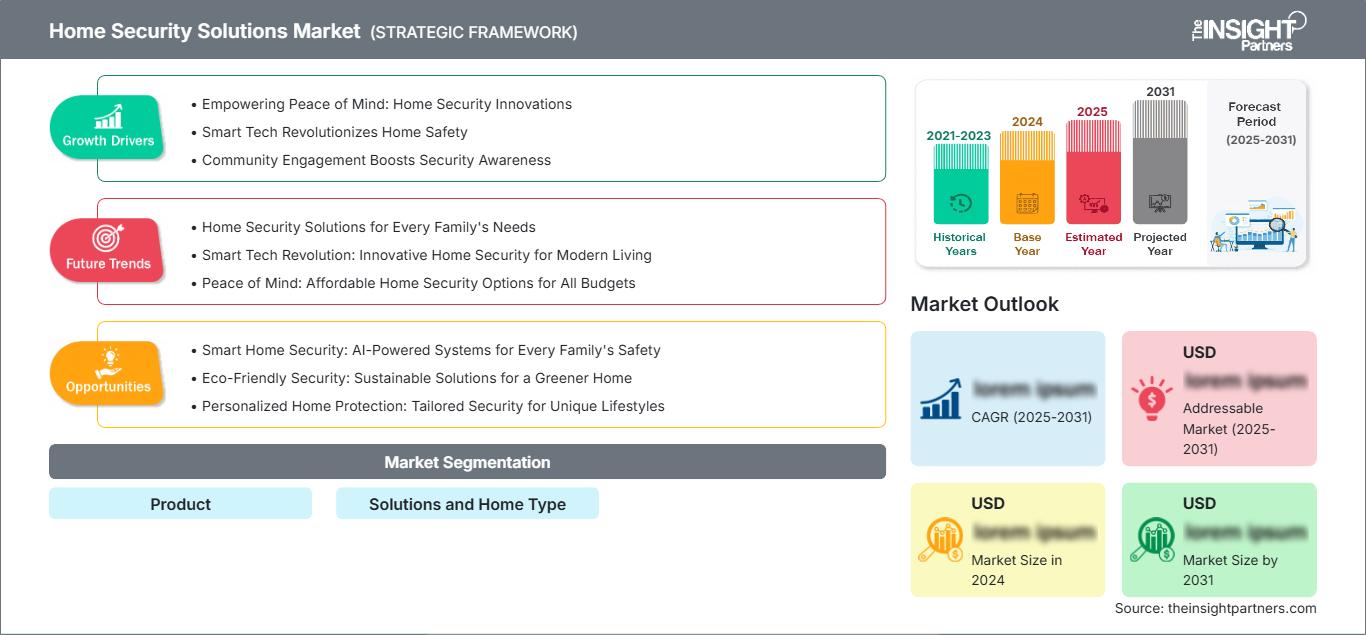
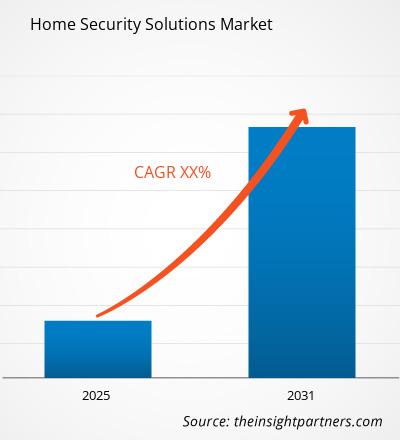
The Home Security Solutions market is valued at US$ 35.67 Billion in 2025 and is projected to reach US$ 130.36 Billion by 2034, advancing at a CAGR of 15.49% during 2026–2034. The growth is seen due to the increased usage of connected products, cloud-based surveillance systems, and protection platforms in the residential properties. The market is set up for further growth due to the increasing integration of connected security, remote surveillance, and intelligent access solutions in residential settings.
North America will be a structurally significant market thanks to the developed professional monitoring infrastructure, the high level of smart home penetration rate, and the need for replacement of legacy products. The estimated Compound Annual Growth Rate of Home Security Solutions Market size in North America during 2026-2034 will be 15-17%.
Home Security Solutions Market Assessment and Insights
- North America: North America is expected to maintain a leading position, with a 2025 share of 32–36% and a CAGR of 15–17% between 2026–2034, supported by professional monitoring infrastructure, connected-device adoption, and replacement of conventional systems.
- US: The US accounts for 72–76% of North American demand in 2025 and is projected to grow at 14–16% CAGR between 2026–2034, led by monitored security and connected cameras.
- Europe: Europe represents a 2025 share of 25–29% and is projected to grow at 13–15% CAGR during 2026–2034, with Germany, the UK, France, Italy, and Spain supporting adoption through connected-home modernization and residential security upgrades.
- Asia Pacific: Asia Pacific holds a 2025 share of 27–31% and is projected to grow at 18–20% CAGR between 2026–2034, led by China, Japan, South Korea, and India as smart-home ecosystems expand.
- Largest Segment: Product is the largest segment, accounting for a 46–50% market share in 2025 and advancing at a 14–16% CAGR during 2026–2034.
- High Growth Segment: Solution is the high-growth segment, holding a 34–38% market share in 2025 and expanding at a 17–19% CAGR during 2026–2034.
- Key companies analyzed in detail: Robert Bosch GmbH, ASSA ABLOY AB, Honeywell International Inc., Allegion plc, Control4 Corporation, Ingersoll Rand Inc., Godrej & Boyce Manufacturing Company Limited, RTX Corporation, Johnson Controls International plc, Alarm.com Incorporated, Frontpoint Security Solutions, Inc., The Brink's Company, Axis Communications AB, SimpliSafe, Inc., ADT Inc., Vivint, Inc.
Source: The Insight Partners' analysis based on proprietary research, government publications, company annual reports, investor presentations, industry databases, and expert interviews.
Protection of residential property has moved away from individual alarms to integrated systems that include cameras, sensors, locks, access credentials, and professional monitoring. Modern hardware includes edge computing, wireless technology, and applications for control purposes, while vendors are trying to find a balance between components availability and localization of manufacturing. Therefore, the Home Security Solutions Market is moving towards interoperable architectures that are capable of performing multiple security-related tasks.
In the forecast period, investments are expected to go into the development of artificial intelligence, privacy-preserving technologies, interactivity, and cybersecurity. In emerging countries, the expansion of urban dwellings and growth of mobile network coverage will become important factors; in developed countries – system updates and subscription-based services. Data security, devices security, fire security, and reliable communication are likely to become more important regulatory factors.
Home Security Solutions Market Report Scope
| Report Attribute | Details |
|---|---|
| Market size in 2025 | US$ 35.67 Billion |
| Market Size by 2034 | US$ 130.36 Billion |
| Global CAGR (2026 - 2034) | 15.49% |
| Historical Data | 2021-2024 |
| Forecast period | 2026-2034 |
Home Security Solutions Market Analysis
Demand is being driven by the union of physical security and connectivity. The expansion of the Home Security Solutions Market has become more dependent on consumer interest in remote viewing, alarm automation, and integrated access control instead of standalone alarms. Value chains range from sensors, cameras, locks, communications devices, cloud computing, monitoring centers, installers, distributors, and software, opening doors for suppliers who can integrate both hardware and services.
The supply side dynamics depend on semiconductors, image sensors, wireless communication chips, battery technology, optics, and cloud security systems. Competing companies for cameras and sensors have to deal with speed of operations and compatibility issues, whereas service providers want dependable equipment that will facilitate installation. Large suppliers have the benefit of economies of scale, whereas specialty suppliers can benefit from software and cybersecurity knowledge.
From the Home Security Solutions Market Report Competitive Analysis, it becomes evident that it is a fragmented market involving diversified technology companies, access companies, security platforms, and professionally monitored companies. Robert Bosch GmbH, ASSA ABLOY AB, Honeywell International Inc., Allegion plc, and Johnson Controls International plc are involved in hardware and integrated security solutions, whereas Alarm.com Incorporated, ADT Inc., SimpliSafe, Inc., and Vivint, Inc. are more focused on digital residential security solutions.
The strategic positioning of players now relies upon their ability to offer diversified products along with digital services. Investments in the industry are centered around artificial intelligence, edge analytics, cloud solutions, identity management, and interoperability solutions. Axis Communications AB offers specialized solutions in imaging and Control4 Corporation in connected-home control. Godrej & Boyce Manufacturing Company Limited improves regional focus for the company, and RTX Corporation and Ingersoll Rand Inc. keep broader technology solutions capability.
● REPORT CUSTOMIZATION
Tailor This Report To Align With Your Specific Business Requirements
This report can be customized to align precisely with your business objectives, scope, and target markets. Customization options include tailored segmentation, geography, competitive analysis, and strategic insights to support informed decision-making.
Customize This Report →WHAT YOU CAN ADJUST
- ● Segmentations
- ● Geography
- ● Competitive Analysis
- ● Language Preferences
Home Security Solutions Market: Strategic Insights
Regional Insights
North America Home Security Solutions Market
North America accounted for 32-36% in 2025 and is expected to grow at a CAGR of 15-17% during 2034. This region enjoys well-developed professional monitoring systems, wide spread of broadband connections, developed network of installers, and significant replacement demand. Increasingly people in this region install their own integrated systems combining various devices like cameras, smart locks, detection devices, and remote control.
The US is the largest country-level market and is responsible for 72-76% of North American demand. Demand in Canada comes from connected home devices and modernization of existing residential homes, and regional players continue upgrading old alarm systems. Increased attention to issues of privacy, cybersecurity, and reliability of wireless communications prompts providers to develop better authentication and communication tools.
U.S. Home Security Solutions Market
The US was responsible for 72-76% of demand from North America in 2025 and is forecast to record a CAGR of 14-16% over 2026-2034. Professional monitoring, DIY installation, smart locks, video doorbells, and video cameras drive the market. Key players include ADT Inc., Alarm.com Incorporated, SimpliSafe, Inc., and Vivint, Inc. Residential exposure is notable with technology vendors contributing to underlying products and solutions.
Trends in the application area are towards systems with combined intrusion, video, access, automation, and environmental alarms. Cloud management allows for less reliance on local control panels, while edge computing is capable of reducing latency and enhancing privacy. Replacements are still relevant because consumers expect their old alarm systems to communicate with new wireless sensors, applications, and third-party smart home ecosystems.
Europe Home Security Solutions Market
Europe had a market share of 25-29% in 2025, and its growth will be steady with a 13-15% CAGR up to 2034, where Germany will serve as a key country-level market. The UK and Germany are demonstrating high acceptance of connectivity services, cameras, and alarms, whereas France, Italy, and Spain are contributing via renovation and smart homes.
The UK is witnessing demand which includes video doorbells, smart locks, professional monitoring, and alerts, owing to the presence of advanced digital infrastructure and security services infrastructure. In contrast, Germany gives more importance to reliable hardware, privacy, interoperability, and professionally installed systems. France, Italy, and Spain are leveraging urban development and smart home services for their market share.
APAC Home Security Solutions Market
APAC had a Home Security Solutions market share of 27-31% in 2025 and is expected to have an 18-20% CAGR, which is the highest among all major regions. The region's major contributors include China, Japan, South Korea, India, and Australia due to their urbanization, adoption of connected homes, and upgrades in their infrastructure.
In China, there are policies favoring smart home connectivity and digitization of infrastructure, India is developing its infrastructure in terms of connected residential solutions, and Japan and South Korea focus on electronics and automation. In Australia, there is a need for integrated monitoring and access systems.
Middle East & Africa Home Security Solutions Market
The Middle East and Africa’s demand is expected to rise at an 11–13% CAGR between 2026 and 2034. Saudi Arabia and UAE dominate the region on account of residential development, digital infrastructure, and smart cities’ investments, while South Africa continues to be an important market for security services with proven surveillance techniques.
Rest of MEA is set to develop steadily with improved connectivity and security infrastructures. Energy-efficient security systems, wireless security system deployments, remote monitoring, and centralization of monitoring will be applicable when the deployment environment is difficult. Large residential and infrastructural developments could drive standardization of security architecture with the UAE emerging as a key regional market.
Segmentation Analysis
Material
The Product segment is projected to expand at a 14–16% CAGR during 2026–2034. Product demand remains anchored in cameras, electronic locks, sensors, alarms, and fire-protection equipment, with replacement cycles increasingly influenced by connectivity, artificial intelligence, battery performance, and interoperability. The Home Security Solutions Market scope therefore extends beyond physical hardware toward devices capable of participating in integrated digital ecosystems.
- Cameras: Cameras remain central to residential monitoring because visual verification supports faster event assessment, remote awareness, deterrence, and integration with cloud or edge analytics.
- Electronic Locks: Electronic locks strengthen access management through credentials, biometrics, mobile control, and temporary permissions, making them strategically relevant for connected homes and multi-occupant properties.
- Sensors: Sensors provide foundational detection for intrusion, occupancy, doors, windows, motion, smoke, and environmental conditions, supporting automated responses across broader security ecosystems.
- Alarms: Alarms remain essential for immediate notification and deterrence, with wireless connectivity increasingly enabling remote arming, monitoring, diagnostics, and integration with cameras and access systems.
- Fire Sprinklers & Extinguishers: Fire protection products complement security deployments by addressing life-safety requirements and expanding the potential for integrated residential monitoring and emergency response.
Solution
The Solution segment is expected to grow at a 17–19% CAGR from 2026 to 2034, faster than hardware alone as households seek coordinated protection. Integrated platforms can consolidate alerts, video, access, and automation, reducing fragmented interfaces and improving operational visibility for residents and professional monitoring providers.
- Intrusion Detection: Intrusion detection remains a core residential function, combining sensors, alarms, cameras, and mobile alerts to identify unauthorized entry and support rapid response.
- Integrated Security Solutions: Integrated solutions connect multiple security functions through unified software, strengthening interoperability and creating greater strategic value for connected households.
- Video Surveillance Solutions: Video surveillance is increasingly enhanced by analytics, remote access, event filtering, and intelligent notifications, supporting both deterrence and incident verification.
- Access Control: Access control is expanding from conventional keys toward digital credentials, biometrics, mobile applications, and remotely managed permissions for household members and visitors.
Home Type
The Home Type segment is forecast to grow at a 15–17% CAGR through 2034. Security requirements differ by dwelling density, ownership structure, entry configuration, and common-area exposure. Condominiums and apartments favor scalable access and shared infrastructure, while independent homes support broader deployments covering perimeters, entrances, interiors, and detached structures.
- Condominiums: Condominiums require coordinated access, visitor management, surveillance, and common-area protection, making interoperable security platforms particularly relevant to property managers and residents.
- Apartments: Apartments favor compact wireless systems, smart locks, cameras, and managed access because installation constraints and tenant turnover can influence deployment decisions.
- Independent Homes: Independent homes generally provide greater scope for perimeter cameras, sensors, smart locks, alarms, and environmental monitoring, supporting comprehensive household security configurations.
Opportunity Snapshot
| End User | Revenue Contribution | Trend Tag | Adoption Stage |
|---|---|---|---|
| Condominiums | Medium | Shared Access | Scaling |
| Apartments | High | Smart Entry | Scaling |
| Independent Homes | High | Whole Home | Mature |
Home Security Solutions Market Growth Drivers and Impact Analysis
Expansion of AI-enabled video and event verification
The advent of artificial intelligence is transforming the way residential security systems handle high amounts of data gathered from cameras and sensors. Rather than sending out alerts about every detection that occurs, intelligent systems are able to classify the detections and differentiate between actual humans and regular activity. In addition, this will help minimize alert fatigue while improving workflow processes. In terms of suppliers of devices, the change will result in increased need for processors, image sensors, software, and secure connectivity. On the other hand, service providers can now distinguish themselves on the basis of their analysis as opposed to hardware alone.
Greater replacement of legacy alarm and access infrastructure
Older residential security systems are facing limitations on their communication devices, lack of interoperability, lack of interface integration, and inability to work with new connected devices. The process of replacing these old security systems leads to demands of wireless sensors, connected panels, smart locks, cameras, and cloud-based systems. The evolution process also shifts the selection criteria since more and more users take into account factors such as ease of installation, application functionality, cybersecurity, and compatibility with new standards along with traditional alarm systems' functionality. Installation companies and service providers get an opportunity to earn money from monitoring, maintenance, upgrades, and services provided for software. Manufacturers benefit if the replacement system allows using some elements of the previous system in addition to new ones.
Rising demand for unified residential safety ecosystems
Households increasingly prefer security systems that can coordinate multiple functions instead of managing separate applications for cameras, locks, alarms, and environmental devices. Unified ecosystems can connect access events with video verification, automate responses based on occupancy, and provide centralized notifications. This integration creates value for both users and service providers because a broader installed base can support higher engagement and more service opportunities. It also raises the importance of interoperability standards, application programming interfaces, identity management, and dependable cloud services. Vendors capable of combining hardware with software can capture more of the customer relationship, while specialized manufacturers can remain competitive through compatibility with major platforms. The resulting ecosystem orientation is reshaping product design, channel partnerships, and recurring-service strategies.
Home Security Solutions Market Future Trends
Privacy-preserving intelligence at the device edge
Future architectures are likely to move more security analytics toward cameras, hubs, and gateways rather than processing every event remotely. This approach can reduce latency, lower bandwidth requirements, and limit unnecessary transmission of sensitive household information. The Home Security Solutions Market trends are therefore expected to favor processors capable of running compact inference models while maintaining reliable performance under changing lighting, network, and occupancy conditions. Vendors will increasingly differentiate through secure model updates, encrypted storage, configurable retention, and transparent data controls. Edge intelligence may also support more resilient operation during temporary cloud or connectivity interruptions. Over time, hybrid architectures combining local decision-making with cloud coordination should become more common, particularly for systems requiring remote monitoring, long-term analytics, and centralized fleet management.
Convergence of security with broader home automation
Security platforms are likely to become more deeply integrated with lighting, climate control, energy management, appliances, and assisted-living functions. Rather than treating security as a separate application, future systems can use occupancy, time, access credentials, and environmental conditions to coordinate multiple household actions. Such convergence should increase the strategic value of common connectivity layers and standardized interfaces. Smart locks may trigger customized lighting, cameras may adjust recording modes based on occupancy, and sensors may coordinate alerts across security and safety functions. This development will require stronger device identity, interoperability testing, cybersecurity management, and user permission controls. Suppliers that design modular platforms can adapt more readily as consumers add devices over several years instead of replacing complete systems.
Home Security Solutions Market Opportunities
Subscription models for integrated residential protection
Service providers can expand recurring revenue by combining equipment, installation, software, monitoring, maintenance, and analytics within flexible subscription packages. Home Security Solutions Market Forecasts increasingly favor business models that monetize the installed base rather than relying exclusively on initial hardware sales. Tiered plans can address different household needs, from self-monitoring and basic alerts to professional monitoring, video analytics, cloud storage, and emergency response. Providers should prioritize transparent pricing, device compatibility, and straightforward migration from legacy systems to reduce customer acquisition friction. Partnerships with insurers, property managers, telecommunications companies, and utilities could broaden distribution while creating additional use cases. The strongest opportunities are likely to emerge where service bundles reduce installation complexity and demonstrate measurable value through automation, response coordination, and equipment lifecycle management.
Security platforms for emerging urban residential developments
Rapid development of apartments, condominiums, and digitally connected housing creates opportunities for standardized security architectures deployed during construction or renovation. Developers can integrate access control, surveillance, intercoms, alarms, and smart locks into common infrastructure, reducing retrofit requirements and enabling centralized administration. Suppliers should develop scalable systems that support multiple dwelling units while maintaining resident-level privacy and credential separation. Local partnerships can improve installation capacity and after-sales service in emerging markets. Opportunities also exist for modular offerings that allow residents to add cameras, sensors, or automation devices after occupancy. The most attractive projects are likely to combine high-density housing with reliable connectivity, property-management software, and demand for digital access. Such deployments can establish installed bases capable of supporting long-term upgrades and recurring services.
Recent Developments
- May 2026: Consistent Infosystems launched a 3MP Wi-Fi Video Doorbell in India for homes and workplaces, featuring 3MP HD imaging, PIR motion detection, two-way audio, night vision, a 166° viewing angle, cloud and SD-card storage, and IP65 weather protection for indoor and outdoor use.
- August 2026: EZVIZ launched a range of connected living products in Australia, expanding its smart-home portfolio beyond security cameras with new solutions designed to provide integrated, connected and convenient home living experiences.
- August 2026: Abode launched the Garage Tilt Sensor and Outdoor Contact Sensor, expanding smart-home security to garages, gates, sheds and other exterior entry points, with features including up to 10 years of battery life, IP66 weather resistance, tamper detection, up to 500 ft connectivity and integration with Abode’s CUE automation engine.
Frequently Asked Questions

- Comprehensive Market Sizing and Forecast Analysis
- Detailed Segmentation Analysis
- In-Depth Market Dynamics Assessment
- Regional and Country-Level Insights
- Competitive Landscape and Company Benchmarking
- Strategic Business Intelligence
Recent Reports
Testimonials

The Insight Partners provided valuable market intelligence that supported our global go-to-market strategy. Their team was professional, responsive, and attentive to our feedback, providing thoughtful analysis and helpful methodological clarifications throughout the project.
Junmo Kim Chief Financial Officer (CFO), Enertech Co., Ltd.
The Insight Partners' SCADA System Market report is comprehensive, with valuable insights on current trends and future forecasts. The team was highly professional, responsive, and supportive throughout. We are very satisfied and highly recommend their services.
RAN KEDEM Partner, Reali Technologies LTDs
I requested a report on a very specific software market and the team produced the report in a few days. The information was very relevant and well presented. I then requested some changes and additions to the report. The team was again very responsive and I got the final report in less than a week.
JEAN-HERVE JENN Chairman, Future Analytica
We worked with The Insight Partners for an important market study and forecast. They gave us clear insights into opportunities and risks, which helped shape our plans. Their research was easy to use and based on solid data. It helped us make smart, confident decisions. We highly recommend them.
PIYUSH NAGPAL Sr. Vice President, High Beam Global
The Insight Partners delivered insightful, well-structured market research with strong domain expertise. Their team was professional and responsive throughout. The user-friendly website made accessing industry reports seamless. We highly recommend them for reliable, high-quality research services
YUKIHIKO ADACHI CEO, Deep Blue, LLC.
This is the first time I have purchased a market report from The Insight Partners.While I was unsure at first, I visited their web site and felt more comfortable to take the risk and purchase a market report.I am completely satisfied with the quality of the report and customer service. I had several questions and comments with the initial report, but after a couple of dialogs over email with their analyst I believe I have a report that I can use as input to our strategic planning process.Thank you so much for taking the extra time and making this a positive experience.I will definitely recommend your service to others and you will be my first call when we need further market data.
JOHN SUZUKI President and Chief Executive Officer, Board Director, BK Technologies
I wish to appreciate your support and the professionalism you displayed in the course of attending to my request for information regarding to infectious disease IVD market in Nigeria. I appreciate your patience, your guidance, and the fact that you were willing to offer a discount, which eventually made it possible for us to close a deal. I look forward to engaging The Insight Partners in the future, all thanks to the impression you have created in me as a result of this first encounter.
DR CHIJIOKE ONYIA MANAGING DIRECTOR, PineCrest Healthcare Ltd.Reason to Buy
- Informed Decision-Making
- Understanding Market Dynamics
- Competitive Analysis
- Identifying Emerging Markets
- Customer Insights
- Market Forecasts
- Risk Mitigation
- Boosting Operational Efficiency
- Strategic Planning
- Investment Justification
- Tracking Industry Innovations
- Aligning with Regulatory Trends





 Get Free Sample for