
Physical Security Market Growth, Trends & Forecast by 2034
Coverage: By Component (Systems and Services); Organization Size (Large Enterprises and SMEs); End users (Residential, Industrial, and Commercial); and Geography (North America, Europe, Asia Pacific, and South and Central America)
- Status : Data Released
- Report Code : TIPTE100000162
- Category : Electronics and Semiconductor
- No. of Pages : 150
- Available Report Formats :


- Last update date : March 25, 2026


2025 Market Size
US$ 116.55 Bn
Base year value
2034 Forecast
US$ 225.6 Bn
Projected by 2034
CAGR 2026-2034
7.61 %
Growth rate
Addressable Market
US$ 1,540.91 Bn
(2026-2034)
The global Physical Security market was valued at US$ 116.55 billion in 2025 and is expected to reach US$ 225.6 billion by 2034; it is estimated to record a CAGR of 7.61% during 2026-2034.
Key market dynamics include an escalating global threat landscape, the rapid integration of Artificial Intelligence (AI) and the Internet of Things (IoT) into surveillance frameworks, and a heightened focus on protecting critical national infrastructure. Additionally, the market is expected to benefit from the rise of smart city initiatives, stringent government mandates regarding public safety, and the increasing adoption of cloud-based security-as-a-service models across commercial and residential sectors.
Physical Security Market Analysis
The physical security market analysis indicates a fundamental shift from reactive monitoring to proactive, intelligence-led protection. Strategic opportunities are emerging in the convergence of physical and cybersecurity, where unified platforms allow organizations to manage digital and physical threats through a single pane of glass. Procurement trends show that enterprises are increasingly moving away from siloed hardware installations in favor of integrated ecosystems that utilize edge computing and AI-driven analytics to reduce response times and minimize false alarms. The analysis also highlights that market expansion is heavily dependent on the scalability of cloud architectures and the ability of vendors to offer interoperable solutions. Competitive differentiation now hinges on smart features such as behavioral biometrics, autonomous drone patrolling, and predictive threat modeling, allowing premium providers to secure high-margin contracts in government and critical infrastructure segments.
Physical Security Market Overview
Physical security is undergoing a digital transformation, evolving from traditional perimeter fencing and analog cameras into a sophisticated network of connected sensors and intelligent software. Once dominated by man-guarding and basic locks, the industry now revolves around high-definition video surveillance, biometric access control, and sophisticated intrusion detection systems. This growth is fueled by the modernization of public spaces and the need for data-driven security in the wake of rising urbanization and global instability. Both established industrial conglomerates and agile tech startups are competing to provide frictionless security experiences that balance rigorous protection with user convenience. As businesses and governments prioritize operational continuity, the demand for resilient, high-tech physical security solutions continues to expand across all major continents. For instance, the market in the US is a mature yet highly innovative sector characterized by a rapid transition toward cloud-based management and AI-integrated surveillance. Driven by heightened internal security concerns and a robust corporate focus on asset protection, the region leads in the deployment of advanced biometric and contactless access solutions.
Market Assessment and Insights
- Global market for Physical Security was valued at US$ 116.55 Billion in 2025
- Annual market size is expected to reach US$ 225.60 Billion by 2034
- Total addressable market (TAM) during 2026-2034 is projected to reach approximately US$ 1,540.91 Billion
- Market is anticipated to register a CAGR of 7.61% during the forecast period
- The United States represents a key market, supported by Growing Security Concerns and Threats, Technological Advancements in Security Solutions, as well as evolving industry dynamics
- Market analysis covers North America, Europe, Asia-Pacific, South and Central America, Middle East and Africa, with growth evaluated across the forecast period
- Market opportunities such as Growth in Smart City and Infrastructure Development, Increasing Demand for Cloud-Based Security Solutions are expected to influence market dynamics and addressable market
- Report profiles industry participants, including Anixter International Inc., Cisco Systems, Inc., CSC, EMC Corporation, Genetec, Honeywell International, Hewlett Packard, IBM Corporation, Lockheed Martin, Schneider Electric SA, while analyzing competitive strategies and innovation developments
-
Source: The Insight Partners' analysis based on proprietary research, government publications, company annual reports, investor presentations, industry databases, and expert interviews.
● REPORT CUSTOMIZATION
Tailor This Report To Align With Your Specific Business Requirements
This report can be customized to align precisely with your business objectives, scope, and target markets. Customization options include tailored segmentation, geography, competitive analysis, and strategic insights to support informed decision-making.
Customize This Report →WHAT YOU CAN ADJUST
- ● Segmentations
- ● Geography
- ● Competitive Analysis
- ● Language Preferences
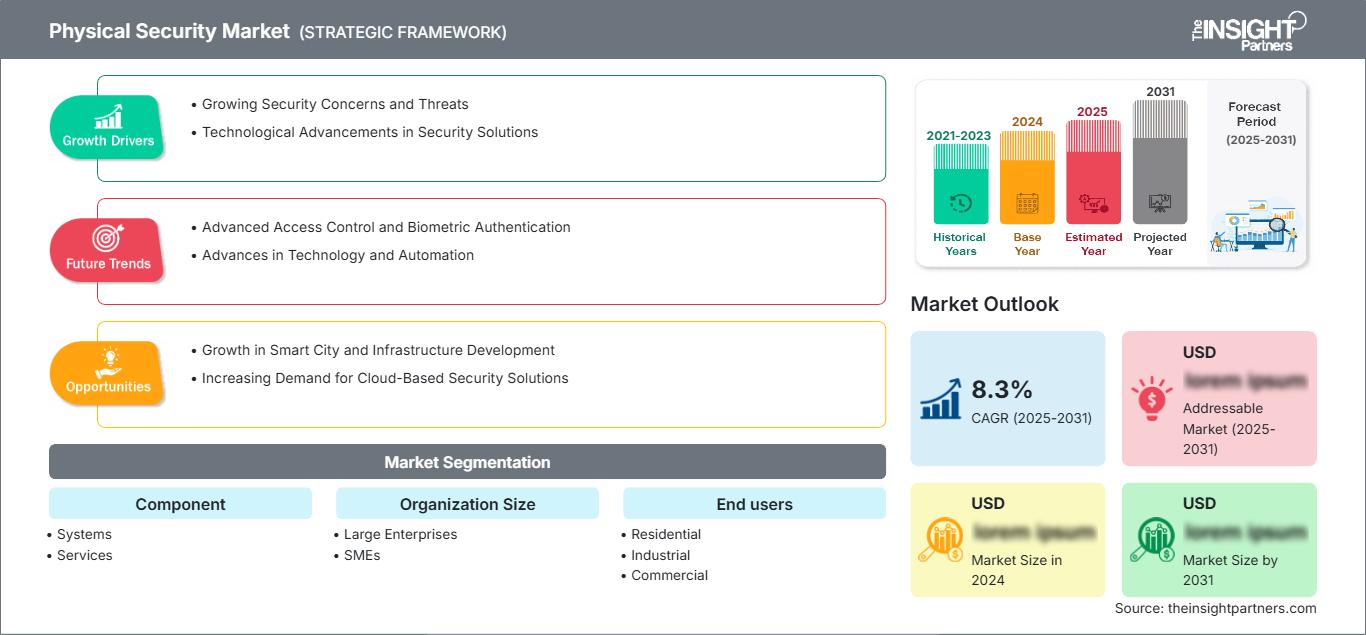
Physical Security Market: Strategic Insights
-
Get Top Key Market Trends of this report.This FREE sample will include data analysis, ranging from market trends to estimates and forecasts.
Physical Security Market Drivers and Opportunities
Market Drivers:
- Rising Global Security Threats and Malicious Activities: Increasing incidences of terrorism, organized crime, and unauthorized physical breaches are compelling organizations to invest in multi-layered security protocols. The need to safeguard high-value assets and human lives remains the primary catalyst for market growth.
- Technological Integration of AI and Machine Learning: The shift toward intelligent surveillance allows for real-time anomaly detection, facial recognition, and automated alerts. These advancements reduce human error and operational costs, making sophisticated security more accessible and effective for diverse end-users.
- Stringent Regulatory Compliance and Mandates: Governments worldwide are implementing rigorous safety standards for public buildings, transportation hubs, and industrial sites. Compliance with these legal frameworks often necessitates the installation of certified fire safety, access control, and monitoring systems.
Market Opportunities:
- Expansion of Smart City Infrastructure: The global push toward smart urbanization creates significant demand for integrated security grids that connect traffic management, public surveillance, and emergency response systems into a unified command center.
- Growth in Cloud-Based Security-as-a-Service (SECaaS): There is a substantial opportunity for vendors to offer scalable, subscription-based models for video surveillance (VSaaS) and access control (ACaaS), appealing to SMEs that require professional-grade security without high upfront capital expenditure.
- Convergence of Physical and Cyber Security: As security hardware becomes increasingly IP-enabled, there is a growing niche for consulting and integration services that protect physical security networks from digital hacking, ensuring a holistic defense posture for modern enterprises.
Physical Security Market Report Segmentation Analysis
The Physical Security Market share is analyzed across various segments to provide a clearer understanding of its structure, growth potential, and emerging trends. Below is the standard segmentation approach used in most industry reports:
By Component:
- Systems: This segment includes the core hardware and software infrastructure, such as video surveillance cameras, biometric readers, electronic locks, and intrusion detection sensors. It represents the largest portion of the market as technology replacement cycles shorten due to AI advancements.
- Services: Encompassing professional and managed services, this segment includes system integration, remote monitoring, maintenance, and consulting. It is the fastest-growing area as organizations seek specialized expertise to manage complex, modern security ecosystems.
By Organization Size:
- Large Enterprises: Typically, the early adopters of high-end, multi-site security solutions, these organizations possess the substantial budgets required for comprehensive perimeter protection and centralized command centers.
- SMEs: A rapidly expanding segment that is increasingly adopting modular and cloud-based security solutions. Government initiatives and falling hardware prices are enabling smaller businesses to implement professional-grade security measures.
By End Users:
- Residential: Driven by the smart home trend, this segment focuses on consumer-grade surveillance, smart locks, and DIY alarm systems to protect private property and enhance personal safety.
- Industrial: Focuses on protecting critical assets in manufacturing, energy, and utility sectors. High-durability equipment and specialized sensors are often required to manage risks in harsh or high-stakes environments.
- Commercial: The dominant segment by volume, covering retail, hospitality, BFSI, and healthcare. These users prioritize loss prevention, crowd management, and regulatory compliance through integrated access and monitoring tools.
By Geography:
- North America
- Europe
- Asia Pacific
- South & Central America
- Middle East & Africa
Physical Security Market Report Scope
| Report Attribute | Details |
|---|---|
| Market size in 2025 | US$ 116.55 Billion |
| Market Size by 2034 | US$ 225.6 Billion |
| Global CAGR (2026 - 2034) | 7.61% |
| Historical Data | 2021-2024 |
| Forecast period | 2026-2034 |
| Segments Covered |
By Component
|
| Regions and Countries Covered |
North America
|
| Market leaders and key company profiles |
|
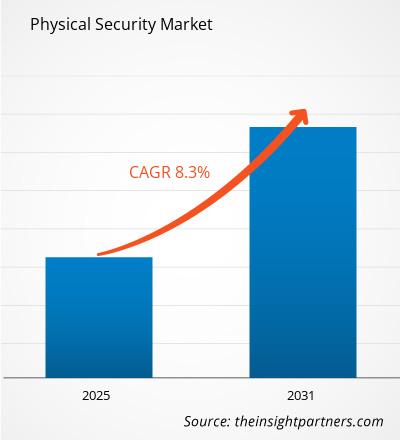
Physical Security Market Players Density: Understanding Its Impact on Business Dynamics
The Physical Security Market is growing rapidly, driven by increasing end-user demand due to factors such as evolving consumer preferences, technological advancements, and greater awareness of the product's benefits. As demand rises, businesses are expanding their offerings, innovating to meet consumer needs, and capitalizing on emerging trends, which further fuels market growth.
Physical Security Market Share Analysis by Geography
North America currently holds the largest share of the global physical security market, while Asia-Pacific is projected to experience the highest growth rate during the forecast period. Emerging markets in the Middle East and Africa are also showing significant potential as they modernize their urban infrastructure and public utilities.
The physical security market is undergoing a significant transformation, moving from traditional analog surveillance to AI-driven, cloud-based intelligence systems. Growth is driven by the rising frequency of security breaches, a surge in smart city investments, and the integration of biometrics into daily commercial operations. Below is a summary of market share and trends by region:
North America
- Market Share: Holds the largest global share, with the US acting as the primary revenue engine.
- Key Drivers:
- Increasing prevalence of sophisticated security threats and data identity theft.
- High demand for cloud-based Security-as-a-Service (VSaaS and ACaaS) models.
- Strict government mandates for critical infrastructure and campus safety.
- Trends: A major shift toward AI-powered video analytics and the transition from traditional CCTV to flexible, high-resolution IP-based systems. There is also a notable trend in domesticating supply chains following recent US policy changes and tariffs on foreign surveillance hardware.
Europe
- Market Share: Commands a significant portion of the market, driven by mature economies like Germany, the UK, and France.
- Key Drivers:
- Rising concerns over public safety and a surge in investments for border security.
- Strict regulatory compliance requirements, including GDPR and the EU AI Act.
- Growing adoption of smart building technologies in the commercial sector.
- Trends: Strengthening focus on cyber-physical security convergence, where IT and physical security teams collaborate to defend against unified threats. There is also a rising preference for managed services to handle complex 24/7 monitoring requirements.
Asia-Pacific
- Market Share: Recognized as the fastest-growing region, heavily influenced by massive urbanization in China and India.
- Key Drivers:
- Aggressive government mandates for smart city 4.0 infrastructure.
- Rapid industrialization and the construction of new mega-transportation hubs.
- Rising middle-class demand for residential smart-home security systems.
- Trends: Dominance of edge-computing surveillance, where real-time analysis occurs directly on the camera. The region is also leading in the integration of security data into Super Apps for seamless urban navigation and safety.
South and Central America
- Market Share: An emerging market with high growth potential in Brazil and Argentina due to near-shoring manufacturing trends.
- Key Drivers:
- Government programs mandating biometric verification for public services.
- Modernization of industrial facilities to meet international safety benchmarks.
- Falling costs of IP-based hardware, making it accessible to smaller businesses.
- Trends: Rapid growth in biometric systems for workplace access control and a shift toward hybrid security models that combine physical guards with cloud-connected AI cameras.
Middle East and Africa
- Market Share: A developing market with a strong focus on high-stakes infrastructure protection in the GCC countries.
- Key Drivers:
- Strategic focus on protecting high-value oil and gas extraction and storage sites.
- Massive investments in futuristic smart cities (e.g., NEOM) and tourism infrastructure.
- Heightened security needs due to regional geopolitical tensions.
- Trends: Heavy implementation of Smart Agriculture and perimeter security using drones and multi-sensor fences. There is also a notable trend in formalizing private security through modern MIL-SPEC (military specification) hardware.
High Market Density and Competition
The physical security market is characterized by high density and intense competition among diversified industrial giants and specialized technology firms. Key players such as Honeywell and Cisco Systems Inc. dominate the high-end project market, while companies like Hikvision and Dahua lead in high-volume hardware sales. This competitive environment pushes vendors to differentiate through:
- Product Ecosystem Integration: Creating seamless one-stop platforms that combine fire safety, HVAC control, and security monitoring.
- AI and Edge Analytics: Developing proprietary algorithms for object classification, loitering detection, and thermal imaging.
- Cyber-Resilience: Hardening physical devices against cyber-attacks to gain trust in highly regulated sectors like BFSI and Government.
Opportunities and Strategic Moves
- Strategic Partnerships: Collaborating with AI software developers and cloud providers (e.g., Microsoft Azure, AWS) to enhance data processing and remote management capabilities.
- M&A Activity: Acquiring niche startups in the biometric and drone-surveillance space to expand product portfolios and stay ahead of the technology curve.
Major Companies operating in the Physical Security Market are:
- Anixter International Inc.
- Cisco Systems, Inc.
- CSC
- EMC Corporation
- Genetec
- Honeywell International
- Hewlett Packard
- IBM Corporation
- Lockheed Martin
- Schneider Electric SA
Disclaimer: The companies listed above are not ranked in any particular order.
Physical Security Market News and Recent Developments
- In April 2025, Mobile Communications America, Inc. (MCA), a leading security integration and critical communications provider, acquired Presidio, Inc.'s Physical Security Integration business. This strategic acquisition underscored MCA's commitment to providing innovative, customizable solutions that enhanced workplace safety, security, and efficiency for its clients.
- In January 2025, Spot AI announced the launch of its Remote Security Agent, which brought significant AI innovation to the physical security guard industry. Building on the company's Video AI Agents launch in November 2024, the Remote Security Agent provided retailers with a more effective approach to addressing rising crime rates in the United States by combining specialized hardware with autonomous AI agents.
Physical Security Market Report Coverage and Deliverables
The Physical Security Market Size and Forecast (2021–2034) report provides a detailed analysis of the market covering below areas:
- Physical Security Market size and forecast at global, regional, and country levels for all the key market segments covered under the scope
- Physical Security Market trends, as well as market dynamics such as drivers, restraints, and key opportunities
- Detailed PEST and SWOT analysis
- Physical Security Market analysis covering key market trends, global and regional framework, major players, regulations, and recent market developments
- Industry landscape and competition analysis covering market concentration, heat map analysis, prominent players, and recent developments in the Physical Security Market.
- Detailed company profiles
Frequently Asked Questions

- Comprehensive Market Sizing and Forecast Analysis
- Detailed Segmentation Analysis
- In-Depth Market Dynamics Assessment
- Regional and Country-Level Insights
- Competitive Landscape and Company Benchmarking
- Strategic Business Intelligence
Recent Reports
Testimonials

The Insight Partners provided valuable market intelligence that supported our global go-to-market strategy. Their team was professional, responsive, and attentive to our feedback, providing thoughtful analysis and helpful methodological clarifications throughout the project.
Junmo Kim Chief Financial Officer (CFO), Enertech Co., Ltd.
The Insight Partners' SCADA System Market report is comprehensive, with valuable insights on current trends and future forecasts. The team was highly professional, responsive, and supportive throughout. We are very satisfied and highly recommend their services.
RAN KEDEM Partner, Reali Technologies LTDs
I requested a report on a very specific software market and the team produced the report in a few days. The information was very relevant and well presented. I then requested some changes and additions to the report. The team was again very responsive and I got the final report in less than a week.
JEAN-HERVE JENN Chairman, Future Analytica
We worked with The Insight Partners for an important market study and forecast. They gave us clear insights into opportunities and risks, which helped shape our plans. Their research was easy to use and based on solid data. It helped us make smart, confident decisions. We highly recommend them.
PIYUSH NAGPAL Sr. Vice President, High Beam Global
The Insight Partners delivered insightful, well-structured market research with strong domain expertise. Their team was professional and responsive throughout. The user-friendly website made accessing industry reports seamless. We highly recommend them for reliable, high-quality research services
YUKIHIKO ADACHI CEO, Deep Blue, LLC.
This is the first time I have purchased a market report from The Insight Partners.While I was unsure at first, I visited their web site and felt more comfortable to take the risk and purchase a market report.I am completely satisfied with the quality of the report and customer service. I had several questions and comments with the initial report, but after a couple of dialogs over email with their analyst I believe I have a report that I can use as input to our strategic planning process.Thank you so much for taking the extra time and making this a positive experience.I will definitely recommend your service to others and you will be my first call when we need further market data.
JOHN SUZUKI President and Chief Executive Officer, Board Director, BK Technologies
I wish to appreciate your support and the professionalism you displayed in the course of attending to my request for information regarding to infectious disease IVD market in Nigeria. I appreciate your patience, your guidance, and the fact that you were willing to offer a discount, which eventually made it possible for us to close a deal. I look forward to engaging The Insight Partners in the future, all thanks to the impression you have created in me as a result of this first encounter.
DR CHIJIOKE ONYIA MANAGING DIRECTOR, PineCrest Healthcare Ltd.Reason to Buy
- Informed Decision-Making
- Understanding Market Dynamics
- Competitive Analysis
- Identifying Emerging Markets
- Customer Insights
- Market Forecasts
- Risk Mitigation
- Boosting Operational Efficiency
- Strategic Planning
- Investment Justification
- Tracking Industry Innovations
- Aligning with Regulatory Trends





 Get Free Sample for