
Smart Lighting Market Analysis, Size, and Share by 2034
Coverage: By Lighting Types (Light Emitting Diode (LED) Lamp, Fluorescent Lamps, Compact Fluorescent Lamps (CFL), Intensity Discharge Lamps, and Others (Neon Lamps and Photographic Flashes)); Application (Industrial Lighting, Residential Lighting, Commercial Lighting, Government, Outdoor Lighting, and Automotive Lighting) and Connectivity Technology (Wired and Wireless), and Geography
- Status : Data Released
- Report Code : TIPTE100000112
- Category : Electronics and Semiconductor
- No. of Pages : 150
- Available Report Formats :


- Last update date : August 18, 2026


2025 Market Size
US$ 18.45 Bn
Base year value
2034 Forecast
US$ 78.33 Bn
Projected by 2034
CAGR 2026-2034
19.8 %
Growth rate
Addressable Market
US$ 455.78 Bn
(2026-2034)
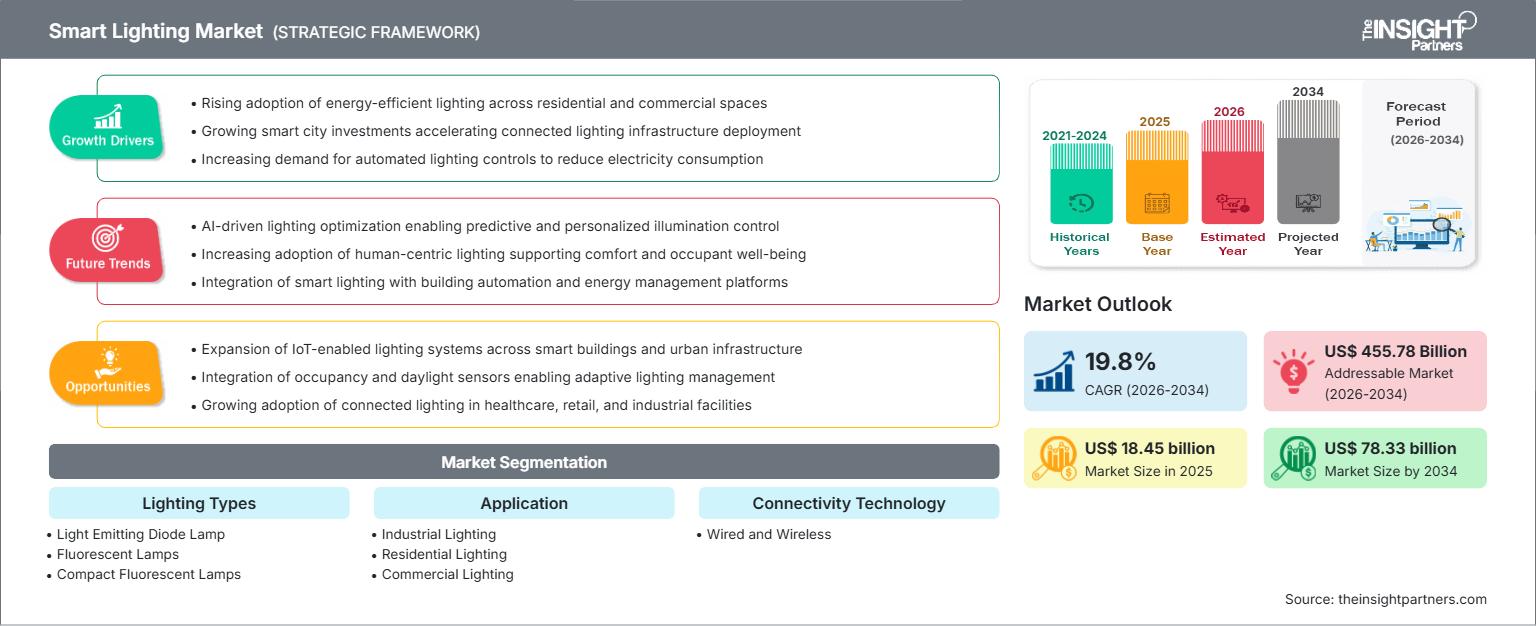
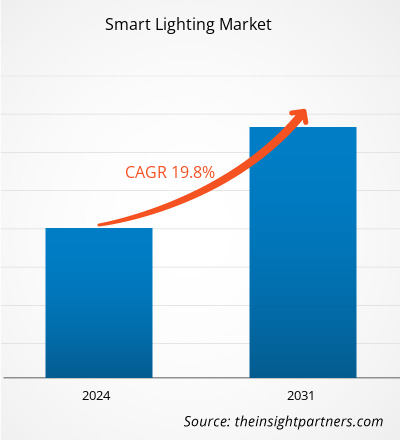
The Smart Lighting Market was valued at US$ 18.45 billion in 2025 and is projected to reach US$ 78.33 billion by 2034, registering a CAGR of 19.8% over the forecast period from 2026 to 2034. This robust growth trajectory reflects the accelerating transition from conventional lighting to intelligent, connected systems that offer significant energy savings, enhanced user control, and seamless integration with broader smart home and building automation ecosystems.
North America holds a substantial share of 28–32% of the global market in 2025, with a projected CAGR of 18–20% from 2026 to 2034. The region's market is propelled by strong consumer adoption of smart home devices, the presence of major technology and lighting companies, and supportive federal efficiency programs like the Better Buildings Initiative that incentivize building modernization and energy optimization, contributing to the expansion of the Smart Lighting Market size.
Smart Lighting Market Assessment and Insights
- North America – Estimated to hold 28-32% of the global market in 2025, growing at a CAGR of 18-20% from 2026 to 2034. This is driven by the widespread adoption of smart home ecosystems, the strong retail presence of smart lighting products, and federal initiatives promoting energy efficiency and building modernization .
- US – Represents approximately 85-90% of the North American market in 2025, with a CAGR of 18-20% projected through 2034. The market is reinforced by high consumer demand for home automation and significant infrastructure modernization investments in the commercial and public sectors .
- Europe – Accounts for 24-28% of the global market in 2025, growing at an estimated CAGR of 18-20% during the forecast period. Germany, the UK, and France are leading the adoption, driven by stringent EU energy efficiency regulations, the European Green Deal, and a strong focus on sustainable building renovations .
- Asia Pacific – Captures 30-34% of the global market share in 2025 and is projected to grow at the fastest CAGR of 21-23% through 2034. China leads the region with massive smart city initiatives and domestic manufacturing capacity, followed by Japan, South Korea, and India .
- Largest Segment – The LED Lamp lighting type segment held the largest share with 60-65% of the market in 2025, growing at a CAGR of 18-20% through 2034, driven by its superior energy efficiency, long lifespan, and compatibility with smart controls .
- High Growth Segment – The wireless connectivity segment is projected as the fastest-growing with a CAGR of 21-23% from 2026 to 2034, due to its ease of installation, scalability for retrofits, and increasing integration with smart home platforms .
- Key companies analyzed in detail – Signify Holding, Legrand North America, LLC, Acuity Brands, Inc., Lutron Electronics Co., Inc., Leviton Manufacturing Co., Inc., Zumtobel Group, Honeywell International Inc., Savant Technologies LLC, Dialight plc, and Panasonic Corporation.
Source: The Insight Partners' analysis based on proprietary research, government publications, company annual reports, investor presentations, industry databases, and expert interviews.
The Smart Lighting Market has evolved from basic energy-efficient bulbs to sophisticated IoT-enabled platforms that integrate sensors, wireless connectivity, and advanced software. The smart lighting solutions that we have today feature such automation capabilities as occupancy detection, daylight harvesting, and remote control. With the technological progress in such areas as LED chips, wireless modules, and control algorithms with artificial intelligence, the cost becomes lower and the functionality much more extended. The industry is moving from selling hardware only to offering hardware-software services.
Emerging geographies, particularly in Southeast Asia, Latin America, and the Middle East, present significant growth opportunities as urbanization accelerates and smart city projects proliferate, supporting expansion in the Smart Lighting Market share. Investment in 5G networks and edge computing infrastructure is enabling more responsive and intelligent systems. Regulatory tailwinds, such as the EU's Ecodesign Directive and the U.S. DOE's efficiency standards, are compelling end-users across residential, commercial, and industrial sectors to invest in smart lighting, ensuring long-term, sustained market expansion.
Smart Lighting Market Report Scope
| Report Attribute | Details |
|---|---|
| Market size in 2025 | US$ 18.45 billion |
| Market Size by 2034 | US$ 78.33 billion |
| Global CAGR (2026 - 2034) | 19.8% |
| Historical Data | 2021-2024 |
| Forecast period | 2026-2034 |
Smart Lighting Market Analysis
The Smart Lighting Market is fundamentally driven by the convergence of energy efficiency requirements, IoT technology proliferation, and the global push toward smart city infrastructure. Governments worldwide are implementing stringent regulations and incentive programs to phase out inefficient lighting technologies, making smart LED systems both an environmental and economic necessity. Growing awareness of sustainability and energy optimization is encouraging the adoption of intelligent lighting solutions across residential, commercial, and public infrastructure applications.
The market value chain has become increasingly complex, encompassing LED chip manufacturers, sensor and wireless communication module providers, fixture manufacturers, software developers, cloud platform providers, and system integrators. These stakeholders collaborate to deliver end-to-end lighting ecosystems that combine connectivity, automation, analytics, and energy management capabilities. Advancements in wireless technologies and IoT platforms continue to expand the functionality and scalability of smart lighting systems.
The competitive landscape features established lighting leaders such as Signify Holding and Acuity Brands, alongside technology-focused companies including Honeywell and Legrand. Market participants are investing heavily in product innovation, strategic partnerships, and platform development to strengthen their positions. Increasing demand for connected environments is driving companies to enhance interoperability, automation capabilities, and user experiences through integrated hardware and software solutions.
Investment trends indicate a clear shift toward AI-enabled analytics, software differentiation, and recurring service-based revenue models. Strategic positioning increasingly depends on ecosystem compatibility, with manufacturers ensuring seamless integration with platforms such as Amazon Alexa, Google Home, and Apple HomeKit. In addition, specialized providers are expanding offerings in human-centric lighting and wellness applications that dynamically adjust color temperature and brightness to support circadian rhythms in offices, healthcare facilities, and educational environments.
● REPORT CUSTOMIZATION
Tailor This Report To Align With Your Specific Business Requirements
This report can be customized to align precisely with your business objectives, scope, and target markets. Customization options include tailored segmentation, geography, competitive analysis, and strategic insights to support informed decision-making.
Customize This Report →WHAT YOU CAN ADJUST
- ● Segmentations
- ● Geography
- ● Competitive Analysis
- ● Language Preferences
Smart Lighting Market: Strategic Insights
Regional Insights
North America Smart Lighting Market
North America is estimated to hold 28–32% of the global market in 2025, with a projected CAGR of 18–20% through 2034, supporting a positive Smart Lighting Market forecast. The USA emerges as the key growth engine due to the strong consumer adoption of smart home solutions and huge investments made in infrastructure upgrades. Government programs such as the Better Building Initiative and Federal Energy Management Program have created an enabling demand environment by emphasizing energy efficiency and green technologies. There is increased demand from the commercial segment to achieve the LEED standards and cut down on operational costs. Key market players such as Signify and Acuity Brands have reinforced their market position with the help of cloud platforms and partnerships.
U.S. Smart Lighting Market
The U.S. market accounts for approximately 85–90% of North American revenue, with a CAGR of 18–20% projected through 2034, reflecting key Smart Lighting Market trends. The widespread adoption of smart home ecosystems and growing commercial building retrofits are key drivers. Retailers and corporate campuses are implementing smart lighting to gain energy savings and enhance occupant comfort. Investments in smart city projects, such as intelligent street lighting in major metropolitan areas, are further accelerating market growth. The presence of leading companies, including Acuity Brands, Lutron, and Eaton, reinforces the U.S.'s dominant market position.
Europe Smart Lighting Market
Europe is estimated to capture 24-28% of the global market in 2025, growing at a CAGR of 18-20% through 2034. Adoption in the region has been spearheaded by Germany because of its advanced industrial nature and the Energiewende initiative introduced by the government to promote energy efficiency. The UK market has been boosted by the high adoption of smart homes and voice control of the lighting system. France, Italy, and Spain are the emerging markets in the region because of the European Green Deal and the Renovation Wave, which seeks to double the energy renovation rate of buildings annually.
APAC Smart Lighting Market
The Smart Lighting Market in Asia Pacific accounted for 30–34% of global market share in 2025 and is projected to grow at the fastest CAGR of 21–23% through 2034. China leads regional adoption with massive urban development projects and government initiatives promoting smart manufacturing and smart cities. The country's "Made in China 2025" initiative prioritizes smart technologies, including intelligent lighting. Japan and South Korea demonstrate strong growth driven by advanced smart home ecosystems and widespread 5G network coverage. India's adoption is accelerating through its Smart City Program and increasing urbanization, with a focus on energy-efficient infrastructure.
Middle East & Africa Smart Lighting Market
The Smart Lighting Market in the MEA region exhibits emerging adoption of smart lighting technologies, with a projected CAGR of 17–19% through 2034. Leading regional investment initiatives like Saudi Arabia’s “Vision 2030” have contributed to the increase in connected lighting adoption as projects like smart city projects in Riyadh and the NEOM project have increased the demand for connected lighting systems. Adoption of connected lighting systems has been further boosted in the UAE due to the Dubai Smart City program and growth in the retail and hospitality sectors. South Africa is the largest market in Africa.
Segmentation Analysis
Lighting Types
The Smart Lighting Market by lighting type comprises Light Emitting Diode (LED) Lamps, Fluorescent Lamps, Compact Fluorescent Lamps (CFL), and High Intensity Discharge (HID) Lamps. LED Lamps dominate the segment, accounting for 60–65% of the market in 2025, driven by their superior energy efficiency, long lifespan, and seamless compatibility with smart controls. The segment is growing at a CAGR of 18–20%. The shift toward LED technology is being accelerated by global regulatory phase-outs of incandescent and other inefficient lighting technologies, making LED the preferred choice for new installations and retrofit projects across residential, commercial, and industrial applications.
- Light Emitting Diode Lamp – The dominant lighting type, favored for its energy efficiency, durability, and controllability. Continuous innovation in color tuning and miniaturization is expanding its application in residential and commercial sectors.
- Fluorescent Lamps – While being phased out in many regions due to efficiency regulations, they still hold a legacy presence in commercial and industrial settings. Smart controls are sometimes retrofitted to these systems as a transitional step.
- Compact Fluorescent Lamps – Similar to fluorescent lamps, they are losing market share to LEDs. Their use is declining rapidly as they are replaced by more energy-efficient and eco-friendly LED alternatives.
- High Intensity Discharge Lamps – Used primarily in outdoor and large industrial applications where high lumen output is required. This segment is seeing a slow decline as LED technology becomes capable of meeting these requirements with better efficiency.
Application
The Smart Lighting Market application segment includes Industrial Lighting, Residential Lighting, Commercial Lighting, Government, Outdoor Lighting, and Automotive Lighting. The Commercial Lighting sector holds the largest market share, driven by the need for energy savings, enhanced operational efficiency, and regulatory compliance. Residential Lighting represents the fastest-growing segment, with a CAGR of 21–23% through 2034, fueled by the proliferation of smart home devices, connected ecosystems, and voice assistants. The Outdoor Lighting segment is also experiencing significant growth due to smart city initiatives, intelligent street lighting projects, and increasing investments in energy-efficient public infrastructure.
- Industrial Lighting – Applications include manufacturing floors, warehouses, and hazardous locations. Demand is driven by the need for energy savings, improved safety, and predictive maintenance through smart controls.
- Residential Lighting – Fastest-growing application, driven by the popularity of smart bulbs, switches, and integration with smart home ecosystems like Amazon Alexa and Google Assistant.
- Commercial Lighting – Largest application, encompassing offices, retail spaces, and hospitality. Demand is propelled by energy codes, green building certifications, and the need for centralized facility management.
- Government – Involves public sector buildings and infrastructure. Smart lighting is adopted to meet sustainability goals and demonstrate energy efficiency leadership in public services.
- Outdoor Lighting – Includes street lighting and area lighting. Growth is fueled by smart city initiatives and the benefits of remote monitoring, adaptive dimming, and improved public safety.
- Automotive Lighting – A specialized segment focusing on intelligent lighting solutions for vehicles, including adaptive headlights and interior ambiance lighting, driven by the automotive industry's focus on safety and user experience.
Connectivity Technology
The Smart Lighting Market connectivity segment includes Wired and Wireless technologies. Wireless connectivity is projected to be the fastest-growing segment, with a CAGR of 21–23% through 2034, driven by its scalability, flexibility, and lower installation costs. While wired systems continue to offer reliability and stable performance, they are increasingly being challenged by the convenience and cost advantages of wireless solutions. The adoption of communication standards such as Zigbee, Bluetooth Mesh, and Wi-Fi 6 is accelerating wireless deployment across residential, commercial, and industrial applications, supporting broader adoption of connected lighting systems.
- Wired – Provides a reliable, interference-free connection. Predominantly used in large-scale commercial and industrial projects where stability is critical, though installation is more complex and costly.
- Wireless – Offers scalability and ease of installation, making it ideal for retrofits and residential applications. The use of protocols like Zigbee, Z-Wave, and Bluetooth Mesh is rapidly expanding.
Opportunity Snapshot
| Application | Revenue Contribution | Trend Tag | Adoption Stage |
| Industrial Lighting | Medium | Smart Factories | Scaling |
| Residential Lighting | High | Home Automation | Scaling |
| Commercial Lighting | High | Smart Buildings | Mature |
| Government | Medium | Smart Cities | Scaling |
| Outdoor Lighting | High | Infrastructure IoT | Scaling |
| Automotive Lighting | Medium | Advanced Lighting | Emerging |
Smart Lighting Market Growth Drivers and Impact Analysis
Energy Efficiency Regulations and Decarbonization Goals
Government initiatives and stringent energy efficiency regulations are primary drivers for the smart lighting market. The EU's Ecodesign Directive and the U.S. Department of Energy's standards have effectively phased out inefficient incandescent lamps, making LED technology a baseline requirement. These regulations also promote the adoption of advanced controls for further energy savings, creating a non-discretionary demand for smart systems in new and retrofit projects. Furthermore, green building certifications like LEED and WELL incentivize smart lighting adoption by awarding points for energy optimization and occupant comfort, accelerating market expansion.
Proliferation of IoT and Smart Home Ecosystems
The growth in the IoT and interoperability due to innovations such as Matter is leading market growth. Smart lighting has become a popular choice for consumers and enterprises because of its compatibility with voice assistants, security systems, and other smart devices. The desire for self-monitoring, self-analysis, and self-reporting technologies for improved energy efficiency and security is another important aspect behind this trend. Such a trend turns the traditional concept of lighting into a smart service, which offers plenty of business opportunities to firms.
Declining Costs and Technological Advancements
Continued reductions in the cost of LED technology, wireless modules, and sensors have lowered the entry barrier for smart lighting systems. Enhanced wireless communication protocols and advancements in AI for predictive analytics are expanding system capabilities within the Smart Lighting Market. This convergence of cost reduction and technological evolution makes smart lighting projects more attractive to end-users, improving the return on investment and driving widespread adoption across diverse applications, from single-family homes to large-scale commercial and municipal projects.
Smart Lighting Market Future Trends
AI-Driven Contextual Lighting and Building Analytics
Artificial Intelligence is set to become a core component of future smart lighting systems. Beyond basic automation, AI will enable predictive maintenance, advanced energy analytics, and dynamic lighting that adapts to specific user activities and environmental conditions. Edge computing will allow lights to be optimized in real-time, and machine learning will enable systems to predict failures and reduce downtime. This evolution will transform lighting infrastructure from a simple cost center into a rich source of data-driven operational insight for building managers.
Human-Centric Lighting for Wellness and Productivity
The emerging focus on human-centric lighting, which aligns with circadian rhythms to improve health and well-being, is a key future trend. This application is gaining significant traction in offices, schools, hospitals, and residential settings as awareness of lighting's biological and psychological impact grows. Manufacturers are developing clinically validated products and wellness-focused ecosystems, moving the market beyond pure energy efficiency towards holistic health solutions. This trend is driving demand for tunable white and color-changing smart bulbs that can mimic natural daylight patterns.
Smart Lighting Market Opportunities
Expansion in Smart City and Outdoor Infrastructure
Significant opportunities exist in the deployment of smart lighting for outdoor and municipal applications. Smart city initiatives are actively deploying connected streetlights to improve public safety, reduce energy consumption, and support data collection for traffic and environmental monitoring. These projects often serve as a foundational layer for broader smart city IoT networks, offering long-term, large-scale contracts for system providers. The integration of 5G infrastructure into smart lighting poles also presents a new revenue stream.
Healthcare and Senior Living Applications
The healthcare sector presents a substantial opportunity, with smart lighting being integrated into hospitals and senior living facilities for fall detection, patient monitoring, and wellness. Innovations such as AI-powered smart lamps that can detect and prevent falls are being deployed in senior housing communities, highlighting the technology's potential to improve patient outcomes and reduce healthcare costs. This application leverages the sophisticated sensor and connectivity capabilities of modern smart lighting systems to provide advanced safety and care functionalities.
Recent Developments
- February 2026: ABB is launching the new System Access Point 3.0 Wireless at Light + Building 2026, extending ABB-free@home Wireless with greater scale, secure remote access, and broader smart home integration. The solution is designed to help installers deliver reliable in-home control and scale projects easily as needs grow.
- November 2025: IKEA is launching 21 new smart home products focusing on lighting, sensors, and control — all built to work with Matter, the universal smart home standard. The launch marks a significant step in making smart home technology easier to use, more affordable, and better adapted to real-life needs in the home. With this launch, IKEA is rebuilding its smart home system and product range from the ground up. The new launch reflects years of development and testing in real homes, and a growing understanding of how people want smart products to work in their daily life.
- November 2025: Signify the world’s leading lighting company, has announced the launch of Philips Smart Light Hub (SLH) in Malappuram, Kerala. Spanning an impressive 2500 square feet, the store features a vast selection of over 500+ SKUs, offering a holistic shopping experience to customers.Located in Malappuram, the 4th largest urban agglomeration in Kerala, this landmark store aims to provide an unmatched home lighting experience for homeowners, interior designers, and architects alike. Featuring a curated range of decorative lighting, functional fixtures, and smart lighting solutions, the store enables customers to explore the latest innovations in lighting technology. With this launch, Signify proudly celebrates the grand opening of its 323rd Philips Smart Light Hub in India, marking a significant milestone in its mission to brighten homes across the country.
Frequently Asked Questions

- Comprehensive Market Sizing and Forecast Analysis
- Detailed Segmentation Analysis
- In-Depth Market Dynamics Assessment
- Regional and Country-Level Insights
- Competitive Landscape and Company Benchmarking
- Strategic Business Intelligence
Recent Reports
Testimonials

The Insight Partners provided valuable market intelligence that supported our global go-to-market strategy. Their team was professional, responsive, and attentive to our feedback, providing thoughtful analysis and helpful methodological clarifications throughout the project.
Junmo Kim Chief Financial Officer (CFO), Enertech Co., Ltd.
The Insight Partners' SCADA System Market report is comprehensive, with valuable insights on current trends and future forecasts. The team was highly professional, responsive, and supportive throughout. We are very satisfied and highly recommend their services.
RAN KEDEM Partner, Reali Technologies LTDs
I requested a report on a very specific software market and the team produced the report in a few days. The information was very relevant and well presented. I then requested some changes and additions to the report. The team was again very responsive and I got the final report in less than a week.
JEAN-HERVE JENN Chairman, Future Analytica
We worked with The Insight Partners for an important market study and forecast. They gave us clear insights into opportunities and risks, which helped shape our plans. Their research was easy to use and based on solid data. It helped us make smart, confident decisions. We highly recommend them.
PIYUSH NAGPAL Sr. Vice President, High Beam Global
The Insight Partners delivered insightful, well-structured market research with strong domain expertise. Their team was professional and responsive throughout. The user-friendly website made accessing industry reports seamless. We highly recommend them for reliable, high-quality research services
YUKIHIKO ADACHI CEO, Deep Blue, LLC.
This is the first time I have purchased a market report from The Insight Partners.While I was unsure at first, I visited their web site and felt more comfortable to take the risk and purchase a market report.I am completely satisfied with the quality of the report and customer service. I had several questions and comments with the initial report, but after a couple of dialogs over email with their analyst I believe I have a report that I can use as input to our strategic planning process.Thank you so much for taking the extra time and making this a positive experience.I will definitely recommend your service to others and you will be my first call when we need further market data.
JOHN SUZUKI President and Chief Executive Officer, Board Director, BK Technologies
I wish to appreciate your support and the professionalism you displayed in the course of attending to my request for information regarding to infectious disease IVD market in Nigeria. I appreciate your patience, your guidance, and the fact that you were willing to offer a discount, which eventually made it possible for us to close a deal. I look forward to engaging The Insight Partners in the future, all thanks to the impression you have created in me as a result of this first encounter.
DR CHIJIOKE ONYIA MANAGING DIRECTOR, PineCrest Healthcare Ltd.Reason to Buy
- Informed Decision-Making
- Understanding Market Dynamics
- Competitive Analysis
- Identifying Emerging Markets
- Customer Insights
- Market Forecasts
- Risk Mitigation
- Boosting Operational Efficiency
- Strategic Planning
- Investment Justification
- Tracking Industry Innovations
- Aligning with Regulatory Trends






 Get Free Sample for