
Air Blower Market Demand, Share & Growth by 2034
Coverage: by Type (Centrifugal Blowers, Positive Displacement Blowers, Helical Screw Blowers, High Speed Blowers, Regenerative Blowers); End-user (Mining Industry, Power Station, Chemical, Food and Beverage, Manufacturing, Others) , and Geography (North America, Europe, Asia Pacific, and South and Central America)
- Status : Data Released
- Report Code : TIPRE00007950
- Category : Manufacturing and Construction
- No. of Pages : 150
- Available Report Formats :


- Last update date : July 13, 2026


2025 Market Size
US$ 3.73 Bn
Base year value
2034 Forecast
US$ 6.77 Bn
Projected by 2034
CAGR 2026-2034
6.86 %
Growth rate
Addressable Market
US$ 47.47 Bn
(2026-2034)
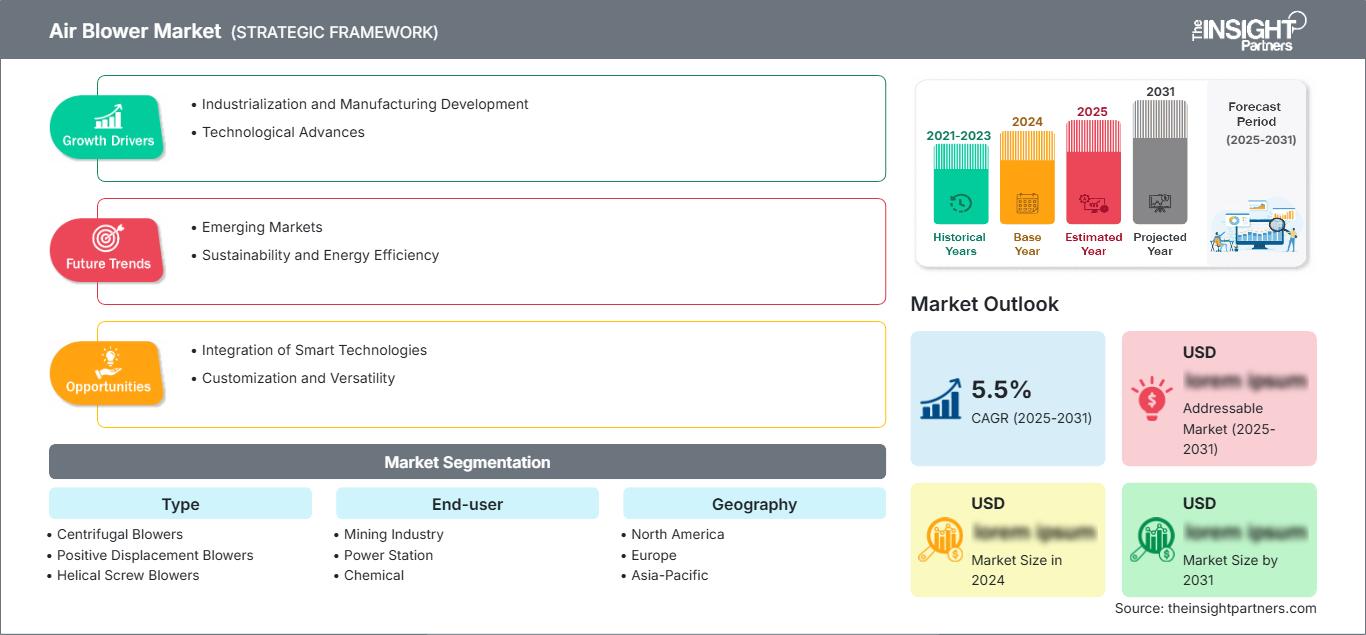
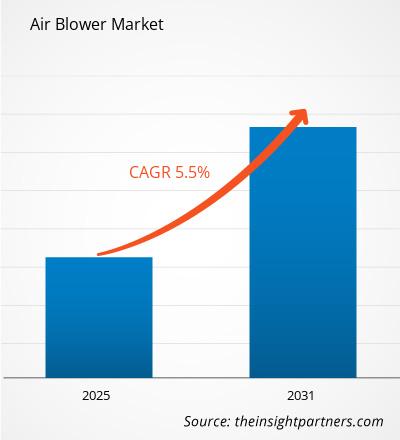
The air blower market is projected to grow from US$ 3.73 Billion in 2025 to US$ 6.77 Billion by 2034, registering a CAGR of 6.86% during 2026–2034. Demand is being shaped by industrial air movement, pneumatic conveying, aeration, cooling, combustion support, and process ventilation across energy-intensive and regulated facilities. Adoption is rising as operators replace legacy systems with efficient, monitored, and lower-maintenance blower platforms.
Across North America, the air blower market size is supported by wastewater upgrades, food processing automation, mining ventilation, and power station retrofits. The region is estimated to expand at a CAGR of 5.9–6.4% during 2026–2034, with replacement demand strengthened by motor-efficiency standards and digital maintenance programs. U.S. manufacturers also benefit from nearshoring, plant modernization, and stricter process safety expectations.
Air Blower Market Assessment and Insights
- North America held 27–30% share in 2025 and is projected to grow at 5.9–6.4% CAGR between 2026–2034, supported by industrial retrofits, wastewater aeration, and compressor service networks.
- US accounted for 72–76% of North America in 2025 and is expected to grow at 6.0–6.5% CAGR between 2026–2034.
- Europe represented 23–26% air blower market share in 2025 and is forecast to grow at 5.6–6.1% CAGR between 2026–2034, led by Germany, the UK, France, and Italy.
- Asia Pacific captured 34–38% share in 2025 and is projected to grow at 7.4–8.1% CAGR between 2026–2034, led by China, India, Japan, and South Korea.
- Largest Segment Centrifugal blowers held 34–38% air blower market share in 2025, growing at 6.4–6.9% CAGR between 2026–2034 due to broad industrial airflow use.
- High Growth Segment High speed blowers held 9–12% market share in 2025, growing at 8.1–8.8% CAGR between 2026–2034 as energy savings become decisive.
- Key companies analyzed in detail: Air Control Industries Ltd, Airtech Blower Industries, Atlantic Blowers, Atlas Copco AB, Compressor Pump and Service, Inc., Everest Blower Systems Pvt. Ltd., Kawasaki Heavy Industries, Ltd., Leister Technologies AG, Savio S.r.l., and Tuthill Corporation.
Source: The Insight Partners' analysis based on proprietary research, government publications, company annual reports, investor presentations, industry databases, and expert interviews.
Industrial consumers are shifting away from single speed and oversized machines towards engineered packages with improved impeller design, VFDs, noise-proof housing, and remote condition monitoring capabilities. Industrial process dynamics are also changing due to the localization of spare parts, use of IE3 and IE4 motors, as well as development of application-specific skids for aeration, furnace air, food drying, and pneumatic conveying. As a result, the blower industry is transitioning from the procurement of equipment to performance throughout its lifecycle.
Geographic regions where the need for growth of wastewater treatment capacity, mineral extraction processes, packaging of food products, and power generation infrastructure is growing will see strong demand for blowers in the future. Industrial efficiency policies matter since the IEA lists the motor systems retrofitting, including fans, pumps, and compressors, as one of the crucial short-term efficiency drivers. Purchasers should favor energy savings, quick service availability, and resilience over lowest costs.
Air Blower Market Report Scope
| Report Attribute | Details |
|---|---|
| Market size in 2025 | US$ 3.73 Billion |
| Market Size by 2034 | US$ 6.77 Billion |
| Global CAGR (2026 - 2034) | 6.86% |
| Historical Data | 2021-2024 |
| Forecast period | 2026-2034 |
Air Blower Market Analysis
The air blower market growth outlook is anchored in continuous-process industries where airflow interruptions affect product quality, emissions control, and plant uptime. Chemical processors require constant pressure for oxidation, drying, and conveying, while food and beverage operations require clean air for drying and packaging. Power stations and mines require large volumes of air for combustion, cooling, ventilation, and dust handling.
The ecosystem is comprised of motor manufacturers, casting and machining firms, control system integration services, distribution companies, service providers, and engineering personnel at the end-user facility. The supply chain is vulnerable to shortages of motors, electrical steel, bearings, and machining. Total cost of ownership is becoming more important to buyers as power requirements over the equipment life cycle may exceed first cost by multiples.
The competitive landscape within the air blower market analysis combines multinational compressed-air groups and specialist blower producers. It shows Atlas Copco AB and Kawasaki Heavy Industries, Ltd. competing through technology breadth and service reach, while Air Control Industries Ltd, Atlantic Blowers, Everest Blower Systems Pvt. Ltd., and Airtech Blower Industries address customized airflow, vacuum, and process requirements.
Investments are made in fast magnetic bearings, oil free systems, intelligent control panels, and regional aftermarket networks. Leister Technologies AG caters to process heat equipment applications, Savio S.r.l. specializes in textile machinery ecosystems, while Tuthill Corporation continues to be relevant in positive displacement equipment applications. Positioning is all about efficient certification, application engineering, reliability in delivering services, and servicing fleet applications from multiple sites.
● REPORT CUSTOMIZATION
Tailor This Report To Align With Your Specific Business Requirements
This report can be customized to align precisely with your business objectives, scope, and target markets. Customization options include tailored segmentation, geography, competitive analysis, and strategic insights to support informed decision-making.
Customize This Report →WHAT YOU CAN ADJUST
- ● Segmentations
- ● Geography
- ● Competitive Analysis
- ● Language Preferences
Air Blower Market: Strategic Insights
Regional Insights
North America Air Blower Market
North America accounted for 27–30% of air blower market share in 2025 and is expected to grow at 5.9–6.4% CAGR during 2026–2034. Replacement demand is strengthened by aging wastewater aeration equipment, greater reliability needs for food processors, and ventilation equipment improvements in chemical and manufacturing companies. Air blower sales are also boosted by a large existing base of compressor, motor, and service equipment in the area.
Regulations on energy efficiency, the trend towards industrial reshoring, and solid municipal investment in infrastructure will drive the purchasing decisions. Purchasing is particularly robust for centrifugal and positive displacement blowers, whereas high-speed blowers are gaining traction within aeration applications with quantifiable lifecycle energy savings. Serviceability is an important consideration since plant managers require quick bearing, seal, impeller, and motor servicing.
U.S. Air Blower Market
The U.S. represented 72–76% of the North America air blower market in 2025 and is projected to grow at a 6.0–6.5% CAGR during 2026–2034. The demands arise from municipal waste water treatment projects, gas fired power generation facilities, mining ventilation and plant upgrades. Atlas Copco AB, Atlantic Blowers, Tuthill Corporation and Compressor Pump and Service, Inc provide services for the industry in terms of equipment provision and application engineering among others.
Current industry trends include low noise blower systems, oil free air system, variable speed systems and predictive maintenance. In food and beverage industries, clean air systems that are wash down compatible are in high demand while in chemical industries there is an increased demand for corrosion resistant material and steady pressure.
Europe Air Blower Market
Europe held 23–26% share in 2025 and is forecast to grow at 5.6–6.1% CAGR during 2026–2034. Germany leads because of chemical processing, machinery, food equipment, and wastewater modernization. The UK shows demand from utilities, manufacturing, and environmental compliance. France, Italy, and Spain contribute through food processing, textile equipment, automotive supply chains, and municipal infrastructure programs.
Pressure on regulations concerning industrial energy consumption leads to an upgrade in energy efficiency motor and control system of airflow. Leister Technologies AG is a provider of process heating, while Savio S.r.l. links the demand for blowers to the textile industry equipment. Buyers from Europe consider low lifecycle emissions, noise performance, and certification as priorities.
APAC Air Blower Market
APAC captured 34–38% share in 2025 and is expected to grow at 7.4–8.1% CAGR during 2026–2034, making it the leading region. China is ahead due to manufacturing volume, wastewater treatment investments, chemical industry and mining sector, whereas India offers demand for process industries, food production facilities, energy assets, and urban development projects.
Japan and South Korea stress accuracy and efficiency, and Australia supplies demand for mining and water treatment sectors. Kawasaki Heavy Industries, Ltd. adds to technological strength of the region, and Everest Blower Systems Pvt. Ltd. ensures economical engineered products. Clean water policy, industrial efficiency and local manufacturing make air blowers structurally attractive.
Middle East & Africa Air Blower Market
Middle East and Africa is projected to grow at 6.2–6.8% CAGR during 2026–2034. The driving demand for Saudi Arabia and UAE is from energy projects, petrochemicals, desalination projects, district cooling projects, and infrastructure. The contribution of South Africa to the market includes projects in mining ventilation, water treatment plants, and food processing.
Rest of MEA demand will be driven by projects where purchasing will be linked to utilities, cement manufacturing, metal industries, and industrial estates. Reliability, toughness, sand filtration capability, and accessibility are key features preferred by buyers. Demand will depend on energy diversification, water projects, and local service providers.
Segmentation Analysis
Type
Type is projected to grow at 6.5–7.1% CAGR during 2026–2034. The air blower market scope by type reflects the balance between proven centrifugal designs, pressure-stable displacement units, screw technologies, high-speed efficiency platforms, and regenerative units for compact applications. Selection depends on pressure ratio, duty cycle, air cleanliness, maintenance skill, and lifecycle energy economics.
- Centrifugal Blowers remain the broadest category, serving ventilation, combustion air, drying, and cooling duties where continuous flow, moderate pressure, and efficient operation support large industrial processes.
- Positive Displacement Blowers are preferred for stable pressure and predictable flow in conveying, wastewater aeration, and process gas movement, especially where reliability outweighs compactness.
- Helical Screw Blowers address users seeking lower pulsation, better efficiency, and quieter performance than traditional lobe systems in medium-pressure continuous-duty installations.
- High Speed Blowers are gaining attention in aeration and clean process air applications because magnetic bearings, compact footprints, and control systems reduce energy and maintenance exposure.
- Regenerative Blowers serve compact, low-pressure applications such as packaging, vacuum handling, aquaculture, and light conveying where simplicity, oil-free operation, and small footprints matter.
End-user
End-user demand is projected to grow at 6.7–7.3% CAGR during 2026–2034. Adoption is linked to industries where air handling supports safety, productivity, environmental control, and product consistency. Mining and power users emphasize ruggedness, while chemical, food, and manufacturing customers increasingly require clean air, digital monitoring, low noise, and verifiable energy savings.
- Mining Industry relies on blowers for ventilation, dust control, flotation, and material movement, with demand tied to safety compliance, equipment durability, and remote-site maintenance constraints.
- Power Station applications include combustion air, cooling, flue gas treatment support, and auxiliary systems, making uptime, redundancy, and efficiency decisive procurement criteria.
- Chemical users require controlled air and gas movement for reactors, drying, conveying, and emissions control, with material compatibility and pressure stability shaping vendor selection.
- Food and Beverage plants use blowers for drying, cooling, packaging, conveying, and sanitation-linked processes, prioritizing clean operation, low contamination risk, and predictable maintenance.
- Manufacturing facilities deploy blowers across machine cooling, pneumatic transport, fume extraction, vacuum handling, and process ventilation, making flexibility and integration central to purchasing.
Opportunity Snapshot
| Segment Name | Revenue Contribution | Trend Tag | Adoption Stage |
| Mining Industry | Medium | Dust Control | Scaling |
| Power Station | High | Combustion Air | Mature |
| Chemical | High | Process Safety | Scaling |
| Food and Beverage | Medium | Hygienic Air | Scaling |
| Manufacturing | High | Factory Retrofit | Mature |
| Others | Low | Utility Support | Emerging |
Air Blower Market Growth Drivers and Impact Analysis
Industrial Energy Efficiency Upgrades
With increasing awareness of energy costs, the industrial buyer is compelled to re-examine conventional, fixed-speed blower configurations. According to the IEA, industries account for almost 40% of total final energy consumption, and the IEA considers the use of efficient motors, fans, pumps, and compressors as opportunities for improving efficiency. In case of high duty aeration, conveying, and ventilation systems, even small improvements in efficiency result in significant savings in operation costs. This factor transforms the buyer’s behavior from simply replacing equipment to evaluating its performance.
Expansion of Water, Wastewater, and Environmental Infrastructure
Aeration is one of the most power-consuming processes in waste water treatment plants and thus, there will be continuous requirement of air supply devices which can deliver reliable aeration. Municipal utilities, industry effluent treatment plants and water recycling systems require reliable oxygen delivery, noise reduction, and minimum down time for maintenance. In this respect, the most affected regions will be APAC, North America, and the Middle East due to capital investments tied up with water security and industrial effluent requirements.
Automation in Process Manufacturing and Food Production
Automated manufacturing plants need reliable air flow to dry, cool, convey, perform vacuum pick-up and exhaust fumes. In addition to food and beverages processing companies needing the ability to clean and integrate cleanly into processes, chemical manufacturers need reliable pressure and process compatibility. The implication here is the importance of engineering packages including blowers, drives, sensors, silencers, and control systems. For manufacturers, this translates to consulting, preventative maintenance and repeat orders from multi-plant accounts.
Air Blower Market Future Trends
Digitally Monitored High-Speed Platforms
The most visible air blower market trends will involve high-speed machines with magnetic bearings, onboard diagnostics, and connected service dashboards. These systems are suited to plants that can monetize lower energy use and reduced lubricant-related maintenance. Over the forecast period, suppliers are expected to bundle analytics, remote alarms, and service agreements with equipment sales. Adoption will first accelerate in wastewater aeration and clean industrial air duties, then broaden into process plants where uptime data supports predictive replacement and standardized lifecycle reporting.
Application-Specific Packaged Blower Systems
In terms of future procurement, systems integrated for certain specific applications will be favored over the stand-alone blower bodies themselves. Manufacturers will design skids for processes such as food dehydration, material transport, mine ventilation, aeration, and auxiliary service to power plant with all drives, silencing equipment, filters, valves, and controls integrated. This will minimize installation risks on the customer side, as well as provide better margin stability for the manufacturer. The development will make regional manufacturing centers more relevant.
Air Blower Market Opportunities
Lifecycle Retrofit Programs for Installed Industrial Fleets
Large installed fleets create an immediate opportunity for suppliers able to audit airflow demand, measure energy waste, and propose phased upgrades without disrupting production. Air Blower Market Forecasts suggest retrofit-led revenue will be particularly attractive where utilities, food processors, and chemical plants operate continuous systems with outdated controls. Vendors can monetize energy assessments, rental bridges, replacement packages, and maintenance contracts. The opportunity favors companies with field engineers, service inventory, and financing partners that help customers justify capital expenditure through operating savings.
Localized Supply and Service Networks in Emerging Economies
Emerging markets require more than equipment availability. Customers need commissioning support, spare parts, motor repair access, and technicians who understand local operating conditions. Suppliers can capture share by establishing distributor training, regional assembly, and application engineering centers near industrial clusters. India, Southeast Asia, the Gulf, and parts of Africa offer attractive potential because water, manufacturing, mining, and power projects often require durable airflow systems. Local service capability can become a stronger differentiator than product specification alone.
Recent Developments
- May 2026: Kawasaki Heavy Industries, Ltd. — signed a contract to provide a MAG Turbo M55 magnetic-bearing-type aeration blower to the Little Blue Valley Sewer District, reinforcing high-efficiency wastewater aeration opportunities for turbo blower technology in municipal infrastructure.
- May 2026: Atlas Copco AB — announced that PowerTech Ar Comprimido Ltda., a Brazilian compressed air distributor serving general industry and mining customers, became part of the group, expanding regional sales and service coverage for compressed-air and related industrial air solutions.
- March 2026: SharkNinja, Inc— announced Shark® BlastBoss™— the only indoor-outdoor air blasting system that converts into a powerful BlastBroom™ to clear, loosen, lift, and sweep debris with ease. With three included attachments, BlastBoss™ tackles messes instantly, delivering adjustable airflow up to 190 MPH* in a compact, cordless design. The all-in-one design is a versatile solution for the garage, patio, car, inside the home, and beyond.
Frequently Asked Questions

- Comprehensive Market Sizing and Forecast Analysis
- Detailed Segmentation Analysis
- In-Depth Market Dynamics Assessment
- Regional and Country-Level Insights
- Competitive Landscape and Company Benchmarking
- Strategic Business Intelligence
Recent Reports
Testimonials

The Insight Partners' SCADA System Market report is comprehensive, with valuable insights on current trends and future forecasts. The team was highly professional, responsive, and supportive throughout. We are very satisfied and highly recommend their services.
RAN KEDEM Partner, Reali Technologies LTDs
I requested a report on a very specific software market and the team produced the report in a few days. The information was very relevant and well presented. I then requested some changes and additions to the report. The team was again very responsive and I got the final report in less than a week.
JEAN-HERVE JENN Chairman, Future Analytica
We worked with The Insight Partners for an important market study and forecast. They gave us clear insights into opportunities and risks, which helped shape our plans. Their research was easy to use and based on solid data. It helped us make smart, confident decisions. We highly recommend them.
PIYUSH NAGPAL Sr. Vice President, High Beam Global
The Insight Partners delivered insightful, well-structured market research with strong domain expertise. Their team was professional and responsive throughout. The user-friendly website made accessing industry reports seamless. We highly recommend them for reliable, high-quality research services
YUKIHIKO ADACHI CEO, Deep Blue, LLC.
This is the first time I have purchased a market report from The Insight Partners.While I was unsure at first, I visited their web site and felt more comfortable to take the risk and purchase a market report.I am completely satisfied with the quality of the report and customer service. I had several questions and comments with the initial report, but after a couple of dialogs over email with their analyst I believe I have a report that I can use as input to our strategic planning process.Thank you so much for taking the extra time and making this a positive experience.I will definitely recommend your service to others and you will be my first call when we need further market data.
JOHN SUZUKI President and Chief Executive Officer, Board Director, BK Technologies
I wish to appreciate your support and the professionalism you displayed in the course of attending to my request for information regarding to infectious disease IVD market in Nigeria. I appreciate your patience, your guidance, and the fact that you were willing to offer a discount, which eventually made it possible for us to close a deal. I look forward to engaging The Insight Partners in the future, all thanks to the impression you have created in me as a result of this first encounter.
DR CHIJIOKE ONYIA MANAGING DIRECTOR, PineCrest Healthcare Ltd.Reason to Buy
- Informed Decision-Making
- Understanding Market Dynamics
- Competitive Analysis
- Identifying Emerging Markets
- Customer Insights
- Market Forecasts
- Risk Mitigation
- Boosting Operational Efficiency
- Strategic Planning
- Investment Justification
- Tracking Industry Innovations
- Aligning with Regulatory Trends





 Get Free Sample for