
AR and VR Smart Glasses Market Size, Share & Growth by 2034
Coverage: By Product (Mobile Phone Smart Glass, Integrated Smart Glass, and External Smart Glass); Type (Binocular and Monocular); and Application (Commercial, Gaming, Industrial, Military, and Education)., and Geography (North America, Europe, Asia Pacific, and South and Central America)
- Status : Data Released
- Report Code : TIPTE100001290
- Category : Electronics and Semiconductor
- No. of Pages : 150
- Available Report Formats :


- Last update date : July 15, 2026


2025 Market Size
US$ 17.40 Bn
Base year value
2034 Forecast
US$ 60.86 Bn
Projected by 2034
CAGR 2026-2034
14.93 %
Growth rate
Addressable Market
US$ 334.68 Bn
(2026-2034)
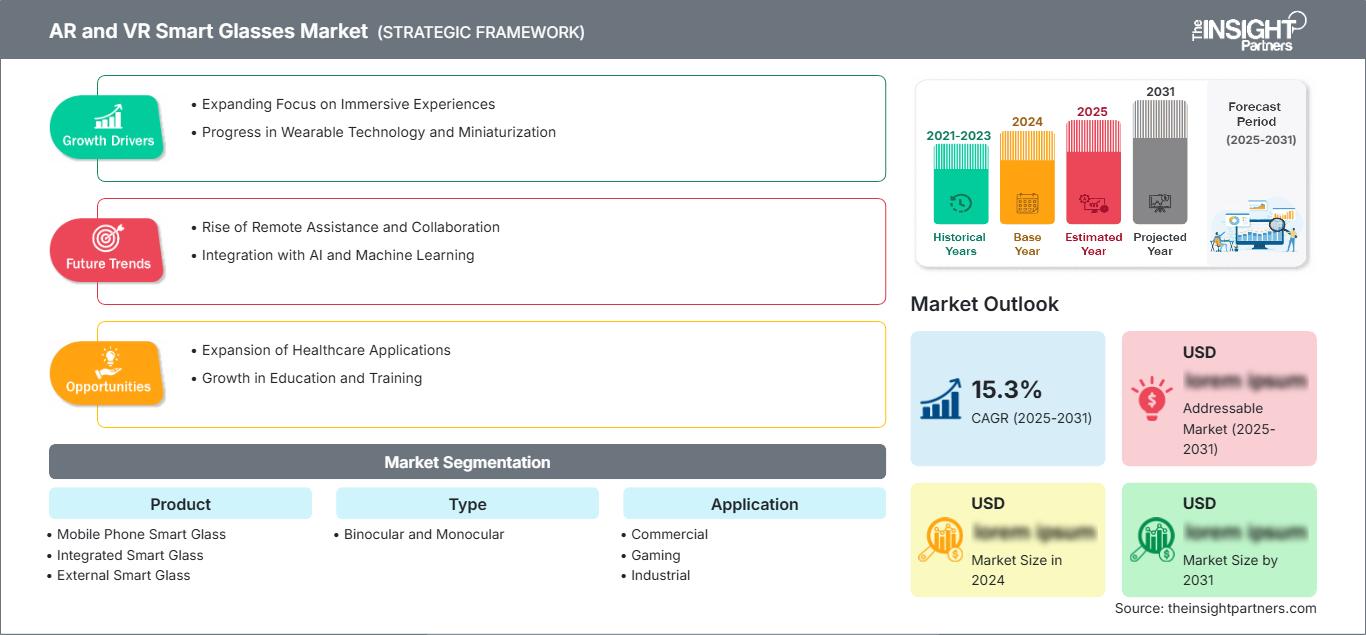
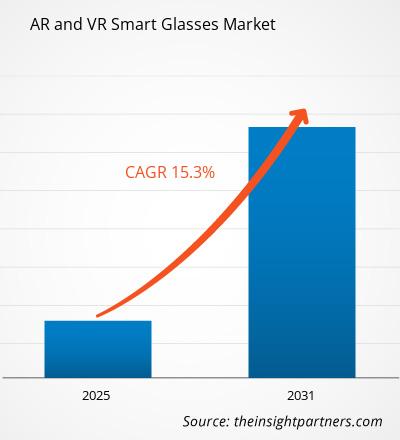
The AR and VR Smart Glasses Market is valued at US$ 17.40 Billion in 2025 and is projected to reach US$ 60.86 Billion by 2034, advancing at a CAGR of 14.93% during 2026–2034. The AR and VR Smart Glasses Market reflects accelerating adoption of wearable spatial computing across consumer entertainment, industrial workflows, military training, education, and commercial productivity environments.
North America remains a high-value adoption base as the AR and VR Smart Glasses Market size expands through enterprise pilots, defense simulation, and early consumer ecosystem development. The region is estimated to grow at a CAGR range of 13.5–15.0% during 2026–2034, supported by advanced 5G coverage, cloud rendering investments, and strong developer activity around Android XR and AI-enabled wearable interfaces.
AR and VR Smart Glasses Market Assessment and Insights
- North America holds an estimated 30–34% share in 2025 and is growing at a CAGR range of 13.5–15.0% during 2022026–2034, led by consumer electronics innovation, defense simulation, and enterprise collaboration deployments.
- US accounts for 78–82% of North American revenue in 2025 and grows at a CAGR of 13.0–14.5%, supported by platform owners, spatial computing developers, and military training demand.
- Europe represents 21–25% share in 2025 and grows at 12.5–14.0% CAGR, with Germany, the UK, and France leading industrial, automotive, and defense use cases.
- Asia Pacific captures 33–37% share in 2025 and expands at 16.0–18.0% CAGR, led by China, Japan, South Korea, and India across gaming, manufacturing, and education adoption.
- Largest Segment is Integrated Smart Glass, holding 42–46% market share in 2025 and growing at 15.0–16.5% CAGR as self-contained devices gain enterprise and premium consumer traction.
- High-Growth Segment is Education, with 8–11% share in 2025 and 17.0–19.0% CAGR, driven by simulation-based learning, remote laboratories, and vocational training programs.
- Key companies analyzed in detail: Google LLC, Vuzix Corporation, HTC Corporation, Seiko Epson Corporation, Avegant Corporation, Atheer, Inc., Samsung Electronics Co., Ltd., Royole Corporation, Optinvent SA, and Kopin Corporation.
Source: The Insight Partners' analysis based on proprietary research, government publications, company annual reports, investor presentations, industry databases, and expert interviews.
Device evolution has moved the AR and VR Smart Glasses Market from tethered headsets and niche enterprise eyewear toward lighter, AI-assisted, phone-linked, and standalone form factors. Optical waveguides, micro-OLED displays, spatial sensors, and low-power processors are shrinking the size and enhancing the field of vision and latency. Production processes are now moving towards a mixed electronics chain and an eyewear supply chain where lens producers, display manufacturers, semiconductor providers, and software platforms need to collaborate on comfort, privacy, heat management, and application approval.
Progress happens when smart glasses actually solve real-world workflow issues instead of being mere devices. Asia Pacific is ramping up production and consumer distribution, whereas North America and Europe are leading military, healthcare, and industrial deployments. Favorable regulatory winds around digital learning, workplace safety, and remote assistance help with deployment, even though device manufacturers still require more clarity on the use of cameras, biometrics, and enterprise cybersecurity.
AR and VR Smart Glasses Market Report Scope
| Report Attribute | Details |
|---|---|
| Market size in 2025 | US$ 17.40 Billion |
| Market Size by 2034 | US$ 60.86 Billion |
| Global CAGR (2026 - 2034) | 14.93% |
| Historical Data | 2021-2024 |
| Forecast period | 2026-2034 |
AR and VR Smart Glasses Market Analysis
The AR and VR Smart Glasses Market growth is supported by rising demand for hands-free visualization, immersive training, and contextual AI assistance. According to IDC, AR/VR headsets and displayless smart glasses will increase shipments in 2025 by 39.2%, reaching 14.3 million, which demonstrates the transition in adoption from early gaming applications to those associated with productivity, communications, and wearable AI.
Ecosystem encompasses optics, displays, processors, batteries, cameras, operating systems, enterprise applications, and cloud rendering. Constraints on supply include microdisplay yield rates, waveguide accuracy, thermal efficiency, and battery capacity. There is a trade-off between integrated processing power versus tethering to phones due to the fact that lighter equipment enhances the adoption rate, whereas enterprise customers require ruggedness and integration with collaboration platforms.
The AR and VR Smart Glasses Market analysis indicates a competitive landscape shaped by platform control, display quality, and enterprise application depth. Google LLC and Samsung Electronics Co., Ltd. are extending their cooperation in Android XR software and hardware, whereas Vuzix Corporation, Seiko Epson Corporation, Atheer, Inc., and HTC Corporation have continued focusing on enterprise processes, training, and remote assistance.
Optics, AI assistant development, spatial mapping technologies, and industrial software alliances are some areas receiving investments. Kopin Corporation and Avegant Corporation have been working in the area of optical and display engines, and Royole Corporation and Optinvent SA have been assisting with specialized wearable display technologies. Positioning in terms of strategy has come to be more and more dependent on developer ecosystems, compatibility with prescription glasses, privacy, and productivity enhancement.
● REPORT CUSTOMIZATION
Tailor This Report To Align With Your Specific Business Requirements
This report can be customized to align precisely with your business objectives, scope, and target markets. Customization options include tailored segmentation, geography, competitive analysis, and strategic insights to support informed decision-making.
Customize This Report →WHAT YOU CAN ADJUST
- ● Segmentations
- ● Geography
- ● Competitive Analysis
- ● Language Preferences
AR and VR Smart Glasses Market: Strategic Insights
Regional Insights
North America AR and VR Smart Glasses Market
North America holds an estimated 30–34% AR and VR Smart Glasses Market share in 2025 and is projected to grow at a CAGR of 13.5–15.0% during 2026–2034. This area sees the advantage of strong consumer electronics purchases, venture financing, defense training budgets, and the introduction of AI-powered wearables in pilot projects.
Clusters of technology in California, Washington, Texas, and Ontario facilitate optics, software, and cloud-rendering research. The Android XR demonstrations in 2025, together with collaborations with eyewear manufacturers, indicate a trend towards practical form factors. The areas of greatest commercial application include remote assistance, field service, defense simulation, visualization in medicine, and collaborative design.
U.S. AR and VR Smart Glasses Market
The U.S. accounts for 78–82% of North American revenue in 2025 and grows at a CAGR of 13.0–14.5% through 2034. There is a noteworthy presence of technology, software, optics, and enterprise value provided by Google LLC, Samsung Electronics Co., Ltd., Vuzix Corporation, Kopin Corporation, Avegant Corporation, and Atheer, Inc.
Application trends reveal high demand for uses of mixed reality in defense mission rehearsals, industrial maintenance, healthcare training, and games. The U.S. market will also be aided by the availability of cloud infrastructure and a development community that could help to build real-time translation, navigation, and AI memory capabilities. Procurement security and battery life are key criteria in decision-making from pilot to fleet procurements.
Europe AR and VR Smart Glasses Market
Europe represents 21–25% share in 2025 and grows at a CAGR of 12.5–14.0%. Germany dominates the regional demand for AR solutions due to its use cases in automotive engineering, factory automation, and industrial training, while the United Kingdom drives deployment in defense, healthcare, and creative content use cases. France, Italy, and Spain are looking into education, tourism, and manufacturing use cases.
The implementation of AR solutions in Europe is driven by the need for privacy under GDPR, safety in the workplace, and digital transformation in the public sector. The United Kingdom and Germany continue dominating the list of countries, yet France is showing potential in aerospace training and medical visualization. Enterprise customers value the security and safety of devices, comfortable optics, multi-language options, and software compatibility.
APAC AR and VR Smart Glasses Market
Asia Pacific captures 33–37% share in 2025 and records the fastest CAGR range of 16.0–18.0% during 2026–2034. China is ahead in terms of regional shipments and manufacturing capabilities, whereas Japan and South Korea are leaders in terms of ecosystems related to display, optics, gaming, and consumer electronics. India and Australia have increasing levels of education, enterprise training, and industry adoption.
Regulatory backing for electronics manufacturing, digital classrooms, and smart factories drives up demand in the region. The capabilities of the device ecosystem in South Korea, optics in Japan, and manufacturing scale in China drive costs down more quickly. India’s training programs for vocations and healthcare technology drive adoption for the long-term and especially for cheaper mobile phone smart glasses.
Middle East & Africa AR and VR Smart Glasses Market Market
The Middle East and Africa grow at a CAGR range of 11.5–13.5%, with Saudi Arabia and the UAE leading adoption through smart city, defense, energy, and tourism modernization programs. South Africa continues to be the most advanced Sub-Saharan country owing to its telecommunications enhancements, business training initiatives, and mining safety solutions.
Smart glasses help energy workers conduct remote inspections, receive work instructions, and collaborate with experts from dangerous locations. Gulf energy infrastructure development requires construction visualization and training. The rest of MEA’s uptake of the technology is inconsistent; however, improved mobile broadband services, reduced device costs, and training materials via cloud computing will drive usage.
Segmentation Analysis
Product
Product segmentation in the AR and VR Smart Glasses Market scope covers mobile phone smart glasses, integrated smart glasses, and external smart glasses. The product segment grows at a CAGR range of 14.0–16.0% as buyers balance portability, compute power, battery life, and cost. Integrated smart glass leads premium enterprise adoption because it reduces dependency on cables and companion processors.
- The mobile phone Smart Glasses rely on smartphones to carry out computing operations, provide connectivity, and applications, enabling more lightweight and cost-effective glasses. The demand is high among consumers, educationalists, and those requiring assistive navigation capabilities.
- Integrated Smart Glasses include processing power, sensors, battery, and display in the same device, which enables their use in enterprise environments, training programs, and industrial activities due to their portable nature, security, and offline capabilities.
- The external Smart Glasses link to an external computing device or controller and have application in gaming, design visualization, and high-level training due to their graphics capabilities and fewer wiring requirements.
Type
Type segmentation includes binocular and monocular devices, growing at a CAGR range of 13.5–15.5% during 2026–2034. Binocular systems support immersive and spatially accurate experiences, while monocular devices remain practical for enterprise notification, instructions, and field service tasks. Selection depends on the required field of view, weight, safety, and duration of use.
- Binocular smart glasses deliver content to both eyes, improving depth perception and immersion for gaming, design review, simulation, and medical visualization, where spatial accuracy and visual continuity are important.
- Monocular smart glasses present information to one eye, reducing weight and power consumption for logistics, maintenance, warehousing, and inspection workflows that require quick contextual data without obstructing surroundings.
Application
Application segmentation covers commercial, gaming, industrial, military, and education use cases, with a CAGR range of 14.5–16.5%. Commercial and industrial buyers focus on productivity and safety returns, gaming drives early consumer familiarity, military users emphasize simulation realism, and education offers the strongest long-term scaling opportunity through immersive learning content.
- The commercial market includes remote collaboration, retail visualization, healthcare assistance, and customer interaction. The highest demand arises in places where smart glasses decrease transportation needs, increase response times, or enable hands-free documentation.
- Gaming still stands out as an application sector, as the industry has immersive content libraries, spatial controllers, and social features that incentivize customers to try new ways of using wearable displays.
- The industrial sector includes maintenance, inspection, quality assurance, warehouse picking, and work instructions. The strategic value is very high because productivity and safety improvements justify repeated investments.
- For the military, the applications are simulations, situation awareness, mission rehearsals, and equipment maintenance. Ruggedization, secure communication, low latencies, and compatibility with current training platforms define procurement.
- Education offers opportunities for virtual labs, anatomy visualization, vocational training, and remote instruction. Adoption is increasing as institutions seek to provide engaging content that enhances skills acquisition.
Opportunity Snapshot
| Application | Revenue Contribution | Trend Tag | Adoption Stage |
| Commercial | High | Remote Assist | Scaling |
| Gaming | High | Immersive Play | Mature |
| Industrial | Medium | Digital Workflows | Scaling |
| Military | Medium | Mission Training | Scaling |
| Education | Low | Virtual Labs | Emerging |
AR and VR Smart Glasses Market Growth Drivers and Impact Analysis
Shift from Headsets to Everyday Wearable Spatial Computing
The market stands to gain from a structural shift towards more lightweight glasses from heavy headsets, integrating a camera, microphone, speakers, display, and AI assistants through an eyewear design. As observed by IDC, smart glasses played a significant role in fueling 2025 shipment momentum, as display-less smart glasses have seen a strong increase due to consumer acceptance of less intrusive wearable technology. Such a shift alters the purchase process since people can enjoy navigation, translations, notifications, and contextual searches without going for an immersive VR experience. On the part of enterprises, the shift reduces training reluctance and allows wearers to use the technology while working.
Enterprise Productivity Gains from Hands-Free Workflows
Industrial and commercial consumers are now evaluating smart glasses using productivity criteria, not just novelty. Guidance from remote experts will result in less need for technicians to move around, work instructions on digital interfaces can eliminate mistakes, and visual logging helps compliance. In manufacturing, utility plants, oil & gas plants, healthcare facilities, and logistics hubs, many industrial processes require both hands of the employee to be free, thus making smart glasses controlled by voice or gestures more effective than tablets. The effect is most pronounced in dispersed facilities that lack specialists with experience. One expert will be able to guide multiple facilities via live video and annotations, thus extending the lifespan of assets. Such a business case is conducive to ongoing software revenue, fleet management, and services.
Platform Investment in AI, Android XR, and Developer Ecosystems
The platform-level investments are bringing about reduced fragmentation and encouraging the creation of scalable applications by developers. Google showcased its Android XR glasses in 2025, which had the features of messaging, navigation, language translations, and the option for an in-lens display capability, while Samsung Electronics Co., Ltd. is developing its XR hardware, which is linked to the same ecosystem. This is important because the adoption of hardware depends on the strength of the software and not just the optics. AI assistants will immediately add value through context awareness, language translations, summaries, and triggering of phone capabilities.
AR and VR Smart Glasses Market Future Trends
AI Context Engines Embedded into Wearable Displays
Trends in the AR and VR smart glasses market indicate that the future of such products will lie in their ability to incorporate context-based AI. This means that instead of merely echoing notifications from phones, smart glasses will be able to understand and contextualize objects, places, documents, speech, and the intentions of users. Google’s 2025 demos were about translating languages, navigating through places, and assisting in a variety of tasks, which shows how wearable AI can make its users’ lives easier. The future glasses will integrate local AI perception with cloud modeling, thus making it possible to provide real-time assistance while minimizing the problem of latency.
Hybrid Optical Architectures for Thinner and Brighter Glasses
Optical design will play a crucial role as firms try to create brighter displays, larger fields of view, and lighter devices. Waveguides, micro-OLED engines, research into microLEDs, and birdbath optics will all co-exist since each is suited for different applications, whether consumer, enterprise, or industrial in nature. Lighter monocular goggles would likely focus on information delivery and instructions, while binocular systems will need immersion and color fidelity. Companies like Kopin Corporation and Avegant Corporation are poised around display engines that can shape the future form factors. However, the winning form factors will balance outdoor performance, prescription support, heat, and yield, but not appear socially awkward.
AR and VR Smart Glasses Market Opportunities
Education and Workforce Training at Scale
Education offers a durable investment opportunity because smart glasses can convert abstract lessons into spatial, repeatable experiences. Technical institutes can use virtual laboratories where students inspect machinery, practice repair steps, or study anatomy without high consumable costs. Employers can train workers on safety procedures and rare failure scenarios before they enter hazardous sites. AR and VR Smart Glasses Market Forecasts indicate the strongest application CAGR range for education at 17.0–19.0%, supported by digital learning programs and workforce reskilling needs. Vendors should target bundled hardware, content libraries, teacher dashboards, and multilingual support because institutions need complete learning systems rather than standalone devices.
Industrial Remote Assistance and Digital Work Instructions
The potential for savings is evident in industry due to the relationship between cost reduction and minimal downtime, rapid training, fewer mistakes, and less travel. Smart glasses could be used to walk workers through checklist processes, superimpose part numbers, enable communications between technicians and experts remotely, and record compliance documentation automatically. The energy, manufacturing, utilities, and logistics segments represent good targets due to the dispersion of facilities and the shortage of skilled labor. Vendors of devices can distinguish themselves by offering rugged construction, replaceable batteries, offline operation capabilities, and secure video conferencing. Software partners can offer task duration analysis and mistake prevention software features.
Recent Developments
- June 2026: Acer, best known for its laptops such as the Acer Swift 16 AI, has expanded its wearable technology lineup by unveiling two new smart glasses that are scheduled to launch later this year. The new products include the Acer GI0, an AI-powered pair of smart glasses, and the Acer AR Vision GR0, augmented reality glasses designed to connect with laptops, smartphones, and gaming devices, including the recently introduced Acer Predator Atlas 8, which was showcased and tested at Computex 2026.
- May 2025: Google LLC. At Google I/O 2025, Google demonstrated Android XR-powered glasses with a camera, microphones, speakers, Gemini integration, an optional in-lens display, messaging, navigation, translation, and photography previews. The company also announced collaborations with Gentle Monster and Warby Parker to develop Android XR smart glasses.
- April 2025: Samsung Electronics Co., Ltd. Samsung and Google were reported to be expanding their XR alliance from Project Moohan into smart glasses planned for release the following year, using Android XR and Gemini-powered assistance for directions, translation, and message summaries.
Frequently Asked Questions

- Comprehensive Market Sizing and Forecast Analysis
- Detailed Segmentation Analysis
- In-Depth Market Dynamics Assessment
- Regional and Country-Level Insights
- Competitive Landscape and Company Benchmarking
- Strategic Business Intelligence
Recent Reports
Testimonials

The Insight Partners' SCADA System Market report is comprehensive, with valuable insights on current trends and future forecasts. The team was highly professional, responsive, and supportive throughout. We are very satisfied and highly recommend their services.
RAN KEDEM Partner, Reali Technologies LTDs
I requested a report on a very specific software market and the team produced the report in a few days. The information was very relevant and well presented. I then requested some changes and additions to the report. The team was again very responsive and I got the final report in less than a week.
JEAN-HERVE JENN Chairman, Future Analytica
We worked with The Insight Partners for an important market study and forecast. They gave us clear insights into opportunities and risks, which helped shape our plans. Their research was easy to use and based on solid data. It helped us make smart, confident decisions. We highly recommend them.
PIYUSH NAGPAL Sr. Vice President, High Beam Global
The Insight Partners delivered insightful, well-structured market research with strong domain expertise. Their team was professional and responsive throughout. The user-friendly website made accessing industry reports seamless. We highly recommend them for reliable, high-quality research services
YUKIHIKO ADACHI CEO, Deep Blue, LLC.
This is the first time I have purchased a market report from The Insight Partners.While I was unsure at first, I visited their web site and felt more comfortable to take the risk and purchase a market report.I am completely satisfied with the quality of the report and customer service. I had several questions and comments with the initial report, but after a couple of dialogs over email with their analyst I believe I have a report that I can use as input to our strategic planning process.Thank you so much for taking the extra time and making this a positive experience.I will definitely recommend your service to others and you will be my first call when we need further market data.
JOHN SUZUKI President and Chief Executive Officer, Board Director, BK Technologies
I wish to appreciate your support and the professionalism you displayed in the course of attending to my request for information regarding to infectious disease IVD market in Nigeria. I appreciate your patience, your guidance, and the fact that you were willing to offer a discount, which eventually made it possible for us to close a deal. I look forward to engaging The Insight Partners in the future, all thanks to the impression you have created in me as a result of this first encounter.
DR CHIJIOKE ONYIA MANAGING DIRECTOR, PineCrest Healthcare Ltd.Reason to Buy
- Informed Decision-Making
- Understanding Market Dynamics
- Competitive Analysis
- Identifying Emerging Markets
- Customer Insights
- Market Forecasts
- Risk Mitigation
- Boosting Operational Efficiency
- Strategic Planning
- Investment Justification
- Tracking Industry Innovations
- Aligning with Regulatory Trends





 Get Free Sample for