Healthcare IOT Security Market Trends, Share & Demand by 2034
Healthcare IOT Security Market Size and Forecast (2021 - 2034), Global and Regional Share, Trend, and Growth Opportunity Analysis Report Coverage: By Component (Solutions, Services); Security Type (Application Security, Cloud Security, Endpoint Security, Network Security, Others); Application (Hospitals, Pharmaceuticals, Medical Devices, Biotechnology, Others) , and Geography (North America, Europe, Asia Pacific, and South and Central America)
Historic Data: 2021-2024 | Base Year: 2025 | Forecast Period: 2026-2034- Status : Data Released
- Report Code : TIPRE00008512
- Category : Technology, Media and Telecommunications
- No. of Pages : 150
- Available Report Formats :


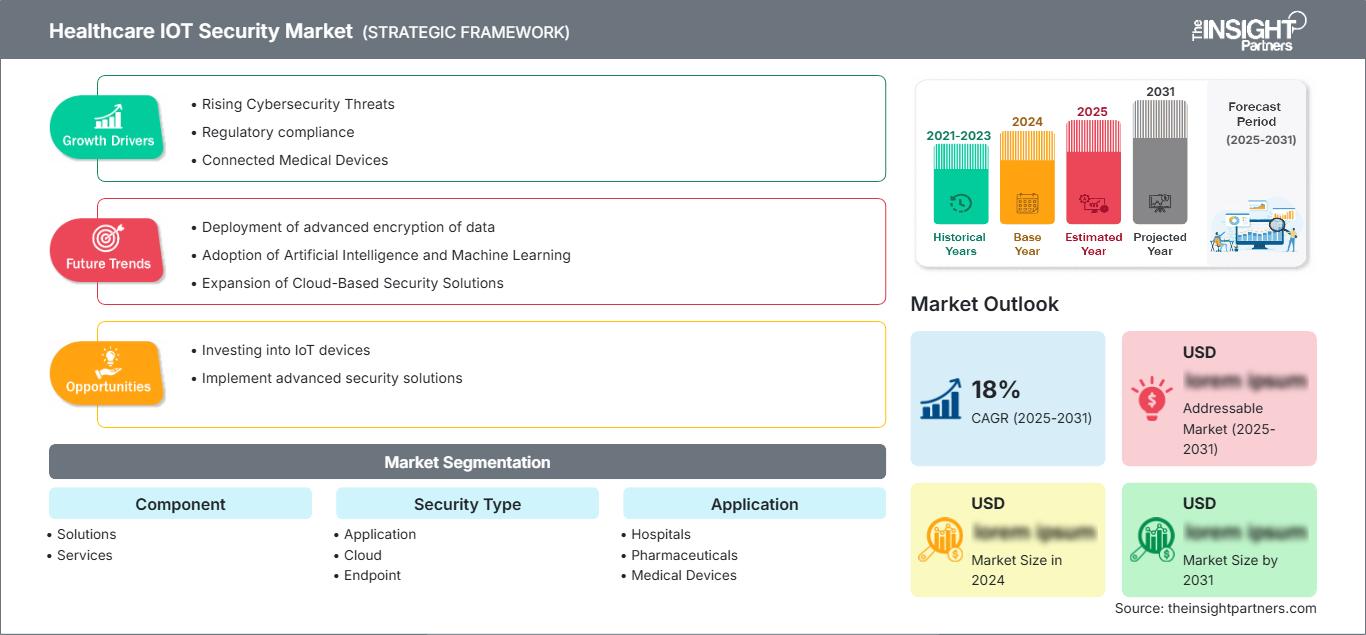
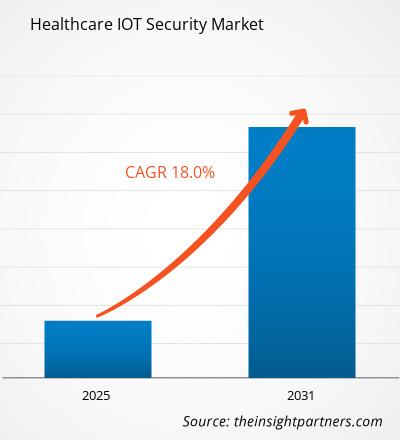
The global Healthcare IOT Security Market size is projected to reach US$11.61 billion by 2034 from US$2.8 billion in 2025. The market is anticipated to register a CAGR of 18.00% during the forecast period 2026–2034
Key market dynamics include the rapid proliferation of the Internet of Medical Things (IoMT), an escalation in high-impact ransomware attacks on hospital networks, and the enforcement of rigid data privacy laws like HIPAA. Additionally, the market is expected to benefit from the rise of telehealth services, the adoption of 5G for real-time remote surgery, and the integration of AI-driven behavioral analytics to identify zero-day vulnerabilities in medical hardware.
Healthcare IoT Security Market Analysis
The healthcare IoT security market analysis shows a trend toward automated asset discovery and risk management. As hospitals become increasingly hyper-connected, identifying every silhouette on the network, from patient monitors to smart beds, is the first line of defense. Procurement trends indicate a move away from legacy perimeter security toward identity-centric and micro-segmentation strategies.
Strategic opportunities are emerging in the security of biotechnology and pharmaceutical supply chains, where the protection of intellectual property and clinical trial data is paramount. The analysis also notes that market expansion depends on overcoming the challenges of legacy medical devices that cannot support modern security agents. Competitive differentiation now stands out for vendors who provide passive monitoring solutions that secure clinical workflows without risking device downtime or interfering with patient care.
Healthcare IoT Security Market Overview
Security in the medical field has evolved from general IT protection into a highly specialized discipline. Healthcare IoT Security encompasses securing wearable health monitors for home care to protecting large-scale imaging systems within surgical centers. Both cybersecurity giants and specialized healthcare startups compete in this market, leveraging technologies like blockchain for data integrity and encrypted communication protocols. Growing demand for integrated healthcare delivery in North America and Europe has increased the reliance on secure cloud-based EHR systems. North America leads in revenue due to high cybersecurity awareness and a dense population of IoT devices. Meanwhile, Asia-Pacific region is advancing through aggressive government-led smart hospital initiatives.
North America market remains the most mature global segment, characterized by a high density of connected medical devices and sophisticated digital health infrastructure. Growth is primarily sustained by strict federal compliance mandates and a proactive stance against escalating ransomware threats targeting clinical operations. Health systems across the region are increasingly transitioning from traditional perimeter defense toward zero-trust architectures to secure decentralized patient data.
Customize This Report To Suit Your Requirement
Get FREE CUSTOMIZATIONHealthcare IOT Security Market: Strategic Insights
-
Get Top Key Market Trends of this report.This FREE sample will include data analysis, ranging from market trends to estimates and forecasts.
Healthcare IoT Security Market Drivers and Opportunities
Market Drivers:
- Explosion of IoMT Connectivity: The transition to smart healthcare has introduced a vast number of endpoints, each acting as a potential entry point for hackers, necessitating specialized IoT security.
- Intensifying Cyber Threat Landscape: Frequent and sophisticated attacks on healthcare systems have made security a top-level budgetary priority for hospital boards to ensure patient safety and business continuity.
- Regulatory Compliance Pressure: New frameworks and international standards are compelling healthcare providers to implement auditable security measures for all connected assets.
Market Opportunities:
- Managed Security Services for Clinics: Providing specialized, remote security monitoring for smaller healthcare facilities that lack the resources for in-house cybersecurity teams.
- Security for Remote Patient Monitoring: Developing secure gateways for the home healthcare market, ensuring that patient data remains encrypted from the wearable device to the clinical dashboard.
- AI-Enabled Threat Detection: Leveraging machine learning to distinguish between normal medical device communications and malicious lateral movement within a network.
Healthcare IoT Security Market Report Segmentation Analysis
The healthcare IoT security market share is analyzed across various segments to provide a clearer understanding of its structure, growth potential, and emerging trends. Below is the standard segmentation approach used in most industry reports:
By Component:
- Solutions: The dominant segment, including software for identity management, intrusion detection, and device authentication.
- Services: A high-growth area focused on consulting, risk assessment, and long-term managed security support.
By Security Type:
- Network: The largest segment, focused on protecting the communication paths between medical devices and hospital servers.
- Endpoint: Essential for securing individual devices like infusion pumps and wearables.
- Cloud: Growing rapidly as more clinical applications and data storage move to virtual environments.
- Application: Focused on the security of medical software and mobile health apps.
- Others: Includes data security and specific hardware-based security modules.
By Application:
- Hospitals: The primary end-user, managing complex networks of diverse medical IoT devices.
- Pharmaceuticals: Focused on securing R&D data and smart manufacturing systems.
- Medical Devices: Driven by manufacturers integrating security-by-design into new products.
- Biotechnology: Protecting sensitive genomic data and proprietary research.
- Others: Includes clinical research organizations and private diagnostic labs.
By Geography:
- North America
- Europe
- Asia-Pacific
- South & Central America
- Middle East & Africa
Healthcare IOT Security Market Report Scope
| Report Attribute | Details |
|---|---|
| Market size in 2025 | US$ 2.8 Billion |
| Market Size by 2034 | US$ 11.61 Billion |
| Global CAGR (2026 - 2034) | 18% |
| Historical Data | 2021-2024 |
| Forecast period | 2026-2034 |
| Segments Covered |
By Component
|
| Regions and Countries Covered |
North America
|
| Market leaders and key company profiles |
|
Healthcare IOT Security Market Players Density: Understanding Its Impact on Business Dynamics
The Healthcare IOT Security Market is growing rapidly, driven by increasing end-user demand due to factors such as evolving consumer preferences, technological advancements, and greater awareness of the product's benefits. As demand rises, businesses are expanding their offerings, innovating to meet consumer needs, and capitalizing on emerging trends, which further fuels market growth.
Healthcare IoT Security Market Share Analysis by Geography
Asia-Pacific is expected to grow fastest in the coming years due to rapid urbanization and the construction of new digital-first medical centers. Emerging markets in South & Central America and the Middle East also have many untapped opportunities for security vendors as these regions modernize their healthcare infrastructure.
The healthcare IoT security market is undergoing a significant transformation, moving from a traditional perimeter-based defense to a global, high-value, adaptive security ecosystem. Growth is driven by the rising prevalence of medical device hijacking (medjacking), a surge in hospital-at-home demand, and the expansion of the digital medical infrastructure sector. Below is a summary of market share and trends by region:
North America
- Market Share: Holds the largest share globally, anchored by advanced digital health maturity and strict federal oversight in the United States and Canada.
- Key Drivers:
- High regulatory pressure from the FDA regarding pre-market cybersecurity submissions for medical devices
- Mainstreaming of Zero Trust security models across large multi-site hospital networks
- Increased adoption of AI-driven threat hunting to protect sensitive Personal Health Information (PHI)
- Trends: Scaling of managed detection and response (MDR) services and the successful integration of cybersecurity into the broader clinical engineering workflow to appeal to risk-averse health systems.
Europe
- Market Share: Holds a significant share, driven by a deep-seated focus on data sovereignty and privacy-first regulations like GDPR and the NIS2 Directive.
- Key Drivers:
- Mandatory cybersecurity certifications for high-risk medical devices under the European Medical Device Regulation (MDR)
- Established manufacturing clusters for specialized diagnostic equipment in Germany, France, and the UK
- Robust government support for cross-border digital health exchange and national sovereign clouds
- Trends: A strategic shift toward prioritizing security for high-margin connected imaging systems. There is also an increasing focus on Software Bill of Materials (SBOM) transparency to meet the demands of security-conscious European healthcare providers.
Asia-Pacific
- Market Share: The fastest-growing region, with New Zealand and Australia acting as primary innovation hubs for digital health policy and secure remote care.
- Key Drivers:
- Massive consumer base in China, India, and Japan seeking modernized, secure telemedicine and mobile health services
- Government-supported smart hospital initiatives focused on 5G-enabled secure data transmission
- Rapid urbanization leading to a preference for westernized, high-tech clinical experiences
- Trends: Heavy reliance on cloud-native security platforms and B2B contracts for securing large-scale IoMT deployments in newly constructed smart clinics across emerging urban centers.
South and Central America
- Market Share: Emerging market with a growing cybersecurity sector in countries like Brazil, Argentina, and Chile.
- Key Drivers:
- Increasing awareness of the legal and financial liabilities associated with healthcare data breaches
- Modernization of private hospital groups into commercial-grade digital entities to supply high-end urban centers
- Rising interest in remote patient monitoring among middle-to-high income segments
- Trends: Growth of security-as-a-service boutique brands and the introduction of secure patient portals to differentiate from the dominant legacy medical market.
Middle East and Africa
- Market Share: Developing market with significant cultural shifts toward digital health, transitioning toward formalized commercial security production.
- Key Drivers:
- National vision programs in Saudi Arabia and the UAE are investing in fully digitalized smart city healthcare
- High demand for secure, shelf-stable diagnostic IoT devices in arid or remote climates
- Strategic investments in localized data centers to improve regional food security and health data sovereignty
- Trends: Implementation of modern biometric authentication and encryption technologies to formalize the informal health market, coupled with a focus on high-security sensors for the pediatric segment.
High Market Density and Competition
Competition is intensifying due to the presence of established leaders such as Cisco Systems, IBM Corporation, and Palo Alto Networks. Specialized security experts and niche players like Armis and Claroty, alongside global innovators such as Fortinet and Check Point, also contribute to a diverse and rapidly expanding market landscape.
This competitive environment pushes vendors to differentiate through:
- Functional and Clinical Branding: Positioning security as a patient safety essential rather than a technical overhead by emphasizing its role in maintaining uptime for life-critical devices like ventilators and infusion pumps.
- Expanded Solution Portfolios: Healthcare IoT security now includes more than just network blocks. Companies offer agentless device discovery, real-time risk scoring, and deep-packet inspection for proprietary medical protocols.
- End-to-End Lifecycle Security: Producers manage the entire security chain, from breeding secure code in the R&D phase to the secure decommissioning of legacy medical equipment.
- New Processing Technologies: Like AI-powered behavioral baselining and sandboxing, which help create high-quality security fingerprints for devices used in clinical, nutraceutical, and beauty-related medical environments.
Opportunities and Strategic Moves
- Partner with high-end medical device OEMs and telehealth platforms to tap into the surging demand for secure, connected care in Asia-Pacific and North American markets.
- Incorporate automated compliance reporting and zero-trust framework certifications to appeal to hospital boards and government regulators seeking ethical and legal data protection.
Major Companies operating in the Healthcare IoT Security Market are:
- Microsoft
- IBM
- Oracle
- Intel Corporation
- AO Kaspersky Lab
- Waracle
- ICterra
- Cisco Systems
- Deutsche Telekom AG
- iTechArt
Disclaimer: The companies listed above are not ranked in any particular order.
Healthcare IoT Security Market News and Recent Developments
- In January 2026, NXP Semiconductors N.V. and GE HealthCare announced a collaboration to pioneer new advancements in edge AI innovation, leveraging NXP’s long history in secure, high-performance edge processing and GE HealthCare’s deep experience in medical technology innovation. The collaboration highlights how the intelligence, low latency, resilience, and security offered by edge AI can transform certain workflows and empower clinicians to deliver improved patient care with simple, actionable insights.
- In February 2025, Royal Philips announced its AI-enabled innovations in precision imaging showcased at the European Congress of Radiology (ECR) annual congress in Vienna. The company aims to accelerate the availability of its cloud-based radiology services to European customers.
Healthcare IoT Security Market Report Coverage and Deliverables
The Healthcare IoT Security Market Size and Forecast (2021–2034) report provides a detailed analysis of the market covering below areas:
- Healthcare IoT Security Market size and forecast at global, regional, and country levels for all the key market segments covered under the scope
- Healthcare IoT Security Market trends, as well as market dynamics such as drivers, restraints, and key opportunities
- Detailed PEST and SWOT analysis
- Healthcare IoT Security Market analysis covering key market trends, global and regional framework, major players, regulations, and recent market developments
- Industry landscape and competition analysis covering market concentration, heat map analysis, prominent players, and recent developments in the Healthcare IoT Security Market.
- Detailed company profiles
Frequently Asked Questions

- Historical Analysis (2 Years), Base Year, Forecast (7 Years) with CAGR
- PEST and SWOT Analysis
- Market Size Value / Volume - Global, Regional, Country
- Industry and Competitive Landscape
- Excel Dataset
Recent Reports
Testimonials

The Insight Partners' SCADA System Market report is comprehensive, with valuable insights on current trends and future forecasts. The team was highly professional, responsive, and supportive throughout. We are very satisfied and highly recommend their services.
RAN KEDEM Partner, Reali Technologies LTDs
I requested a report on a very specific software market and the team produced the report in a few days. The information was very relevant and well presented. I then requested some changes and additions to the report. The team was again very responsive and I got the final report in less than a week.
JEAN-HERVE JENN Chairman, Future Analytica
We worked with The Insight Partners for an important market study and forecast. They gave us clear insights into opportunities and risks, which helped shape our plans. Their research was easy to use and based on solid data. It helped us make smart, confident decisions. We highly recommend them.
PIYUSH NAGPAL Sr. Vice President, High Beam Global
The Insight Partners delivered insightful, well-structured market research with strong domain expertise. Their team was professional and responsive throughout. The user-friendly website made accessing industry reports seamless. We highly recommend them for reliable, high-quality research services
YUKIHIKO ADACHI CEO, Deep Blue, LLC.
This is the first time I have purchased a market report from The Insight Partners.While I was unsure at first, I visited their web site and felt more comfortable to take the risk and purchase a market report.I am completely satisfied with the quality of the report and customer service. I had several questions and comments with the initial report, but after a couple of dialogs over email with their analyst I believe I have a report that I can use as input to our strategic planning process.Thank you so much for taking the extra time and making this a positive experience.I will definitely recommend your service to others and you will be my first call when we need further market data.
JOHN SUZUKI President and Chief Executive Officer, Board Director, BK Technologies
I wish to appreciate your support and the professionalism you displayed in the course of attending to my request for information regarding to infectious disease IVD market in Nigeria. I appreciate your patience, your guidance, and the fact that you were willing to offer a discount, which eventually made it possible for us to close a deal. I look forward to engaging The Insight Partners in the future, all thanks to the impression you have created in me as a result of this first encounter.
DR CHIJIOKE ONYIA MANAGING DIRECTOR, PineCrest Healthcare Ltd.Reason to Buy
- Informed Decision-Making
- Understanding Market Dynamics
- Competitive Analysis
- Identifying Emerging Markets
- Customer Insights
- Market Forecasts
- Risk Mitigation
- Boosting Operational Efficiency
- Strategic Planning
- Investment Justification
- Tracking Industry Innovations
- Aligning with Regulatory Trends




 Get Free Sample For