
Tunable Filters Market Share, Size & Demand by 2034
Coverage: by Form Factor (Standalone, With Monitor and Mobile); Component (Hardware and Service); and End-User (Healthcare, BFSI, Retail, Manufacturing, Government, Education, IT & Telecom and Transportation & Logistics), and Geography (North America, Europe, Asia Pacific, and South and Central America)
- Status : Data Released
- Report Code : TIPEL00002432
- Category : Electronics and Semiconductor
- No. of Pages : 150
- Available Report Formats :


- Last update date : October 30, 2026


2025 Market Size
US$ 1.42 Bn
Base year value
2034 Forecast
US$ 2.62 Bn
Projected by 2034
CAGR 2026-2034
7.02 %
Growth rate
Addressable Market
US$ 18.22 Bn
(2026-2034)
The Tunable Filters Market was valued at US$ 1.42 Billion in 2025 and is projected to reach US$ 2.62 Billion by 2034, registering a CAGR of 7.02% during 2026–2034. The market covers wavelength-selective hardware and associated services delivered in standalone, monitor-integrated, and mobile form factors across healthcare, BFSI, retail, manufacturing, government, education, IT & telecom, and transportation & logistics environments.
North America remains a commercially mature center for optical networking, test instrumentation, medical imaging, and defense-grade sensing, with revenue expected to expand at ~6% CAGR through 2034. Dense data-center interconnects, continued laboratory automation, and demand for precise spectral control support replacement and new-system purchases. The Tunable Filters Market size also benefits from a concentrated photonics supplier base and established channels serving OEM, research, and telecom customers.
Tunable Filters Market Assessment and Insights
Regional Outlook
- North America: ~36% of the global market in 2025 | ~6% CAGR through 2034. Market position: The region ranks first, supported by advanced optical test infrastructure, coherent-network upgrades, biomedical imaging demand, and a deep base of photonics integrators.
- US: ~82% of North American market revenue in 2025 | ~6% CAGR through 2034. Market position: The US leads North America through telecom laboratories, hyperspectral research, defense sensing, and domestic specialist suppliers serving both instrument and embedded-module requirements.
- Europe: ~27% of the global market in 2025 | ~7% CAGR through 2034. Market position: A mature photonics ecosystem and strong scientific instrumentation demand sustain adoption, with Germany leading Europe and the UK and France providing meaningful application depth.
- Asia Pacific: ~29% of the global market in 2025 | ~9% CAGR through 2034. Market position: Asia Pacific is the fastest-growing region as China, Japan, and South Korea expand optical-component manufacturing, while India and Australia broaden telecom and sensing deployment.
Segment Outlook
- Hardware: ~78% Share in 2025 | ~7% CAGR through 2034. Market position: Hardware leads because filters, RF drivers, controllers, and packaged optical assemblies account for most system value and require application-specific precision.
- Mobile: ~18% Share in 2025 | ~9% CAGR through 2034. Market position: Mobile systems grow fastest as field inspection, portable spectroscopy, and distributed diagnostics favor compact, low-power wavelength selection outside centralized laboratories.
Competitive Coverage
Santec AOC Corporation, EXFO Inc., Gooch & Housego plc, Brimrose Corporation of America, Kent Optronics, Inc., Micron Optics, Inc., Analog Devices, Inc., DiCon Fiberoptics, Inc., Netcom, Inc., Smiths Interconnect
Methodology
The Insight Partners follows Data Collection & Secondary Research, Primary Research, Data Analysis, and Data Triangulation & Final Review to validate market estimates and insights.
Source: The Insight Partners' analysis based on proprietary research, government publications, company annual reports, investor presentations, industry databases, and expert interviews.
Filter architectures have evolved from manually adjusted laboratory filters to electrically controlled MEMS, acousto-optical, liquid-crystal, and programmable free space filters. Customers now look at tuning speed, insertion loss, isolation, pass band, repeatability, and package size in tandem rather than considering just wavelength range as the only purchasing criterion. Manufacturing is hence evolving towards more stringent optical alignments, automatic calibrations, and control electronics. Suppliers also compete in application engineering since filters tuned for coherent channel selection are different from those used in fluorescence microscopy, hyperspectral inspection, or near infrared process monitoring.
Prior to 2034, increases in capacity at the Asia Photonics Clusters and local OEMs will improve access without making the application engineering specifications any less critical. The development in terms of government spending on semiconductor fabrication plants, quantum computing, broadband telecommunication, and advanced medical facilities is creating a need for the spectrally selective filters. When making purchasing decisions, there will be a greater emphasis on the traceability of calibrations, low power consumption, and life cycle management, but export controls and component sourcing will help in dual sourcing, giving geographic access without losing the performance benefits of the optical engineers.
Tunable Filters Market Report Scope
| Report Attribute | Details |
|---|---|
| Market size in 2025 | US$ 1.42 Billion |
| Market Size by 2034 | US$ 2.62 Billion |
| Global CAGR (2026 - 2034) | 7.02% |
| Historical Data | 2021-2024 |
| Forecast period | 2026-2034 |
Tunable Filters Market Analysis
Tunable Filters Market growth is based on increased wavelength management challenges in coherent communications, spectroscopy, machine vision, and biomedical imaging. Increased density of channels and wider range of spectral operations boost the demand for filters able to tune bands without mechanical exchange. Customer base consists of OEM system integrators, telecom labs, universities, hospitals, industrial inspection teams, and public research institutions, providing a diverse revenue stream rather than a single application.
Ecosystem commences from optical crystals, coating, MEMS wafers, gratings, detectors, RF electronics, and precision mechanics through filter assembly, calibration, software integration, distribution, and field services. Supply chain is technically difficult because of alignment tolerance and environmental stability influencing the performance of passband. Extended qualification cycles are favorable for the existing suppliers, but modular control system and standard interface can be favorable for new clients.
Competitive Tunable Filters Market Report highlights a competitive market divided into the broad photonics instrument supplier companies and the companies with unique tuning mechanism. Santec AOC Corporation and DiCon Fiberoptics, Inc. focus on MEMS and telecom related modules. EXFO Inc. caters to test workflow of laboratories and manufacturing operations. Gooch & Housego plc and Brimrose Corporation of America have a strong presence in imaging, spectroscopy, and laser systems using acousto-optic design.
The investment trends are narrowing down the linewidth, automating production process, integrated attenuation, digitizing control, and application specific packaging. Analog Devices, Inc. helps provide signal chain capability, while Kent Optronics, Inc., Micron Optics, Inc., Netcom, Inc., and Smiths Interconnect have their participation in the business with specialized optical, sensing, and connectivity capabilities. Strategic positioning would depend on optical performance, qualification capability, and OEM volume ramp.
● REPORT CUSTOMIZATION
Tailor This Report To Align With Your Specific Business Requirements
This report can be customized to align precisely with your business objectives, scope, and target markets. Customization options include tailored segmentation, geography, competitive analysis, and strategic insights to support informed decision-making.
Customize This Report →WHAT YOU CAN ADJUST
- ● Segmentations
- ● Geography
- ● Competitive Analysis
- ● Language Preferences
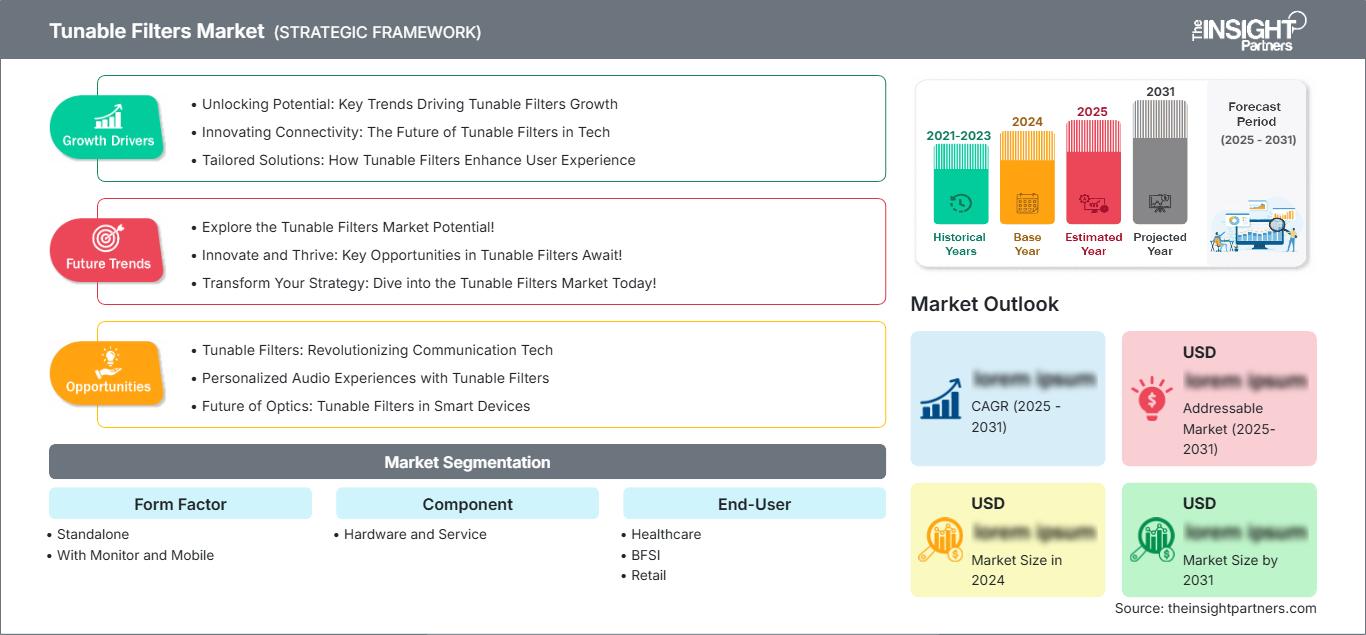
Tunable Filters Market: Strategic Insights
Regional Insights
North America Tunable Filters Market
The North American market is projected to be about 36% of the worldwide revenue by 2025 and grow at a rate of about 6% CAGR during 2025-2034. North American Tunable Filters Market shares depend on an extensive infrastructure of optical communications laboratories, hyperspectral analysis facilities, biophotonic imaging equipment, and military-sensing applications. The focus is on top-quality standalone devices and embedded units where repeatability, stability of passbands, and technical assistance are required.
The growth is moderate and not the highest one on a global scale since several fields of application have already reached maturity; nevertheless, the upgrading of coherent networks, AI-enabled internet traffic, quantum photonics experiments, and laboratory automation contribute to investments in expansion and replacement. The regional supply chain also plays its role since buyers tend to evaluate filters in parallel with lasers, optical spectrum analyzers, detectors, and RF components.
U.S. Tunable Filters Market
The US accounts for ~82% of North American revenue in 2025 and is expected to record ~6% CAGR through 2034. Its position within North America rests on a large concentration of telecom equipment development, federal and university research, aerospace sensing, semiconductor inspection, and life-science instrumentation. These applications reward low insertion loss, high isolation, fast wavelength access, and compact packaging.
There is a greater supply of suppliers, hence more room for commercialization. There are DiCon Fiberoptics, Inc., Brimrose Corporation of America, Kent Optronics, Inc., Analog Devices, Inc., and Smiths Interconnect that provide adequate components or control and integration. Foreign companies can help in sales and applications in the US market. This technology has moved from laboratory application to OEM modules for optical sensing, spectrometry, and machine inspection, but the qualification, traceability, and durability are key considerations for purchase.
Europe Tunable Filters Market
The European market accounts for ~27% of the global revenue in 2025 and is projected to grow at ~7% CAGR to 2034. Germany is the top country in Europe on the back of industrial automation, optical metrology, automobile sensing, and strong precision-engineering capabilities. The UK contributes with photonics production, defense applications, academic R&D, and Gooch & Housego plc providing additional strength in acousto-optic products.
France benefits from applications related to aerospace, telecommunication, and scientific instrumentation; on the other hand, Italy provides applications in relation to machine vision, analysis, and specialized manufacturing. The country of Spain can be described as a small country that is growing and developing with increased research and development activity within the areas of photonics, communications, and remote sensing. In Europe, users require filters that can be applied to reprogrammable instruments.
The European market growth will be driven by R&D funding, sovereign technology initiatives, and updates of fiber communication and industrial inspection infrastructure. The well-established purchasing procedures result in long qualification periods but help in establishing stable vendor relationships after selection of the components. The best prospects exist when the suppliers offer optical products along with calibration, software solutions, and engineering services.
APAC Tunable Filters Market
Asia Pacific holds ~29% of global revenue in 2025 and is the fastest-growing region at ~9% CAGR through 2034. China is the leading country in Asia Pacific because of its scale in telecom equipment, electronics manufacturing, machine vision, and photonics supply chains. Japan and South Korea add advanced optical-component, display, semiconductor, and research demand.
Telecom testing, defense sensing, and technical research are some areas where India is growing its activities, while in Australia, there are contributions in the form of astronomy, environmental monitoring, and university photonics. Industrial policies, localization, 5G, and data center infrastructure, along with the increased domestic manufacture of instruments, help in the increased adoption.
Middle East & Africa Tunable Filters Market
The Middle East & Africa market is projected to grow at ~7% CAGR through 2034. The UAE is positioned as the leading country in the Middle East & Africa where photonics demand is supported by smart infrastructure, security imaging, healthcare investment, and research partnerships. Saudi Arabia adds opportunities in energy analytics, industrial inspection, and communications modernization.
South Africa is the strongest sub-Saharan base within the region for activities in astronomy, sensing for mining applications, education institutions and telecom testing. The Rest of MEA market is project driven, where the requirement depends on fiber optics installations, environmental testing and scientific instruments imports. Suppliers who provide distributor training and remote calibration will have an advantage in this fragmented market.
Segmentation Analysis
Form Factor
Form Factor is expected to expand at ~7% CAGR during 2026–2034. The Tunable Filters Market scope across standalone, with-monitor, and mobile configurations reflects different balances of precision, portability, and workflow integration. Laboratory and production users favor stable bench platforms, while field teams increasingly require compact systems. Interface simplicity, environmental tolerance, automated wavelength control, and compatibility with existing optical benches or handheld instruments determine selection.
- Standalone: Standalone units remain important in R&D, telecom qualification, spectroscopy, and production lines because they provide flexible connectivity, precise manual or electronic control, and straightforward integration with lasers, detectors, and analyzers.
- With Monitor: Monitor-integrated configurations support faster setup and closed-loop operation by combining wavelength selection with direct status visibility. They are strategically relevant for manufacturing test, network diagnostics, and repeatable laboratory procedures.
- Mobile: Mobile filters address field inspection, portable spectroscopy, environmental sensing, and distributed maintenance. Compact packages, low power demand, rugged operation, and simplified controls make this the fastest-growing form factor.
Component
Component revenue is projected to rise at ~7% CAGR through 2034. Hardware contributes the largest share because optical assemblies, actuators, drivers, controllers, packaging, and calibration create most bill-of-material and engineering value. Services remain essential where customers require custom spectral profiles, integration, maintenance, recalibration, or application support. The segment’s economics favor vendors that combine repeatable manufacturing with high-touch engineering.
- Hardware: Hardware dominates purchasing as filter modules and complete instruments directly determine wavelength range, bandwidth, insertion loss, isolation, switching speed, and reliability. OEM design wins can generate recurring production demand.
- Service: Service demand follows customization and lifecycle needs, including optical design, system integration, calibration, repair, and technical training. It is strategically important for protecting performance after installation and reducing customer qualification risk.
End-User
End-User demand is forecast to increase at ~8% CAGR during 2026–2034 as wavelength-selective functions spread from telecom laboratories into healthcare imaging, industrial inspection, public research, and portable sensing. Requirements differ materially by sector: healthcare emphasizes image fidelity and compliance, manufacturing prioritizes throughput and robustness, and IT & telecom values channel selectivity and automation. This diversity supports both standardized platforms and customized modules.
- Healthcare: Healthcare adoption centers on fluorescence imaging, microscopy, spectroscopy, and diagnostic instrumentation. Rapid wavelength switching and stable spectral selection support multi-marker workflows, while compact designs aid integration into clinical and research platforms.
- BFSI: BFSI demand is selective, focusing on secure optical systems, document authentication, imaging, and data-center diagnostics. Procurement favors dependable, serviceable equipment rather than high-volume embedded deployment.
- Retail: Retail applications include material recognition, quality inspection, authentication, and emerging spectral analytics. Adoption remains targeted, with strongest value where optical filtering improves automated identification or loss-prevention workflows.
- Manufacturing: Manufacturing uses tunable filters in machine vision, semiconductor inspection, process spectroscopy, and laser systems. High throughput, repeatability, and rugged packaging make this a strategically significant industrial customer group.
- Government: Government demand spans defense sensing, remote observation, environmental monitoring, laboratories, and public research. Long qualification cycles are balanced by requirements for specialized performance and sustained support.
- Education: Universities and technical institutes purchase configurable filters for photonics teaching, spectroscopy, quantum optics, and exploratory imaging. Flexible wavelength coverage and accessible software increase utilization across research groups.
- IT & Telecom: IT & telecom is a core application base for channel selection, optical monitoring, transceiver testing, ROADM emulation, and noise suppression. Network speed upgrades sustain demand for narrower, programmable filters.
- Transportation & Logistics: Transportation & logistics applications include cargo inspection, machine vision, infrastructure sensing, and optical communications. Mobile and ruggedized configurations are particularly relevant for distributed operating environments.
Opportunity Snapshot
| End Users | Revenue Contribution | Trend Tag | Adoption Stage |
| Healthcare | High | Spectral Imaging | Scaling |
| BFSI | Low | Secure Optics | Emerging |
| Retail | Low | Material ID | Emerging |
| Manufacturing | High | Inline Spectroscopy | Scaling |
| Government | Medium | Remote Sensing | Mature |
| Education | Medium | Photonics Research | Mature |
| IT & Telecom | High | Channel Testing | Mature |
| Transportation & Logistics | Medium | Cargo Imaging | Emerging |
Tunable Filters Market Growth Drivers and Impact Analysis
Higher-Speed Optical Networks Require Precise Channel Control
Coherent transmission, denser wavelength plans, and faster transceivers increase the cost of spectral leakage and inadequate channel isolation. Tunable filters allow laboratories and manufacturers to select channels, shape passbands, suppress amplified noise, and emulate network elements without maintaining large inventories of fixed filters. As network equipment moves through successive speed generations, test benches need broader tuning ranges and narrower, repeatable bandwidths. The market impact extends from standalone development tools to compact modules embedded in transceivers and monitoring systems. Vendors able to deliver low insertion loss, steep filter edges, stable calibration, and automated control can capture both initial equipment purchases and follow-on qualification demand across production lines.
Spectral Imaging Moves into Operational Workflows
The use of hyperspectral and multispectral imaging technologies is evolving from research to healthcare, manufacturing, agriculture, security, and environmental monitoring applications. Tunable filters can help select wavelengths instantly without any physical filter wheel, enabling compact devices and increased spectral data. In manufacturing, the technology enables identification of materials or defects that would go unnoticed by ordinary color cameras. In health care and life sciences, the technology helps in electronically selecting excitation/detection wavelengths for fluorescence and microscopy applications. The effect on the market will be greater variety in customer base and increased need for custom optics solutions.
Miniaturization Expands Embedded and Field Deployment
MEMS packaging, integrated drivers, lower-voltage actuation, and improved micro-optics are reducing the footprint and power burden of wavelength-selective systems. Smaller filters can be embedded closer to detectors, transceivers, or portable spectrometers, reducing optical-path complexity and enabling mobile use. This expands the addressable base beyond centralized laboratories to field maintenance, distributed sensing, point-of-use diagnostics, and compact industrial instruments. Commercially, miniaturization changes buying behavior: OEMs increasingly evaluate filters as design-in components with multiyear production potential rather than one-off laboratory accessories. Success therefore depends on manufacturability, environmental qualification, connector options, firmware stability, and the supplier’s capacity to support customer redesign cycles.
Tunable Filters Market Future Trends
Software-Defined Spectral Control
Tunable Filters Market trends point toward software-defined instruments that coordinate filter wavelength, bandwidth, attenuation, detector settings, and acquisition sequences through a single control layer. This architecture can support automated calibration, remote diagnostics, repeatable recipes, and adaptive measurement based on incoming signal conditions. Over the forecast period, value will shift partly from discrete optical performance toward system intelligence and ease of integration. Suppliers that expose stable interfaces and support common laboratory or industrial protocols can reduce customer engineering time. The change also creates service opportunities in workflow configuration and validation, while increasing the importance of cybersecurity and firmware maintenance for network-connected instruments.
Hybrid Photonic Integration and Multi-Function Modules
Future designs are likely to combine tunable filtering with attenuation, monitoring, switching, or detection in fewer packages. Integrated modules reduce alignment steps, connector losses, board space, and system assembly time, which is valuable in coherent transceivers, compact analyzers, and portable sensing systems. Hybrid photonic integration will not eliminate free-space or acousto-optic platforms, because aperture, power handling, and wavelength coverage remain application dependent. Instead, the market will support parallel architectures optimized for embedded telecom, broadband imaging, and laboratory flexibility. Competitive advantage will increasingly depend on co-design across optics, MEMS, electronics, thermal management, and control software rather than isolated component specifications.
Tunable Filters Market Opportunities
Localized OEM Partnerships in Asia Pacific
Asia Pacific’s manufacturing depth and ~9% regional CAGR create an opportunity for suppliers to establish application engineering, calibration, and light-assembly capabilities near telecom, semiconductor, imaging, and industrial customers. Tunable Filters Market Forecasts favor vendors that can shorten prototype cycles while maintaining optical consistency across production volumes. Investment priorities include regional demonstration laboratories, distributor certification, dual-language software, and local inventory for critical modules. Partnerships with instrument makers can secure design-in positions before specifications become fixed. The opportunity is not simply lower-cost production: proximity allows faster customization around connectors, drivers, spectral bands, and environmental requirements, improving conversion from evaluation units to recurring OEM orders.
Application-Specific Platforms for Healthcare and Industry
Healthcare imaging and industrial spectroscopy reward solutions engineered around a workflow rather than a generic wavelength specification. Vendors can invest in preconfigured filter-driver-software combinations for fluorescence panels, material inspection, process analytics, or portable diagnostics. Such platforms reduce integration risk for customers without requiring suppliers to build complete end systems. Commercial action should focus on reference designs, validated optical paths, calibration routines, and partnerships with camera, detector, laser, and instrument companies. A modular approach can preserve customization while reusing qualified subsystems. This opportunity supports stronger margins and recurring service revenue because performance depends on calibration and application knowledge as much as on the filter element itself.
Recent Developments
- September 2025: Mercury Systems introduced three new digitally tunable bandpass filter banks covering 4–20 GHz, designed for receiver preselection, harmonic rejection, and sub-band filtering in compact 5 mm QFN packages.
- 2026: Microwave Products Group showcased its new tunable filters and expanded switch capabilities, highlighting solutions aimed at evolving RF test and performance requirements and further product integration.
- October 2025: TMOS researchers developed a nanoengineered thermo-optically tunable infrared bandpass filter that uses heat to shift its transmission window, potentially enabling smaller, lower-cost, and more robust infrared spectroscopy systems
Frequently Asked Questions

- Comprehensive Market Sizing and Forecast Analysis
- Detailed Segmentation Analysis
- In-Depth Market Dynamics Assessment
- Regional and Country-Level Insights
- Competitive Landscape and Company Benchmarking
- Strategic Business Intelligence
Recent Reports
Testimonials

The Insight Partners provided valuable market intelligence that supported our global go-to-market strategy. Their team was professional, responsive, and attentive to our feedback, providing thoughtful analysis and helpful methodological clarifications throughout the project.
Junmo Kim Chief Financial Officer (CFO), Enertech Co., Ltd.
The Insight Partners' SCADA System Market report is comprehensive, with valuable insights on current trends and future forecasts. The team was highly professional, responsive, and supportive throughout. We are very satisfied and highly recommend their services.
RAN KEDEM Partner, Reali Technologies LTDs
I requested a report on a very specific software market and the team produced the report in a few days. The information was very relevant and well presented. I then requested some changes and additions to the report. The team was again very responsive and I got the final report in less than a week.
JEAN-HERVE JENN Chairman, Future Analytica
We worked with The Insight Partners for an important market study and forecast. They gave us clear insights into opportunities and risks, which helped shape our plans. Their research was easy to use and based on solid data. It helped us make smart, confident decisions. We highly recommend them.
PIYUSH NAGPAL Sr. Vice President, High Beam Global
The Insight Partners delivered insightful, well-structured market research with strong domain expertise. Their team was professional and responsive throughout. The user-friendly website made accessing industry reports seamless. We highly recommend them for reliable, high-quality research services
YUKIHIKO ADACHI CEO, Deep Blue, LLC.
This is the first time I have purchased a market report from The Insight Partners.While I was unsure at first, I visited their web site and felt more comfortable to take the risk and purchase a market report.I am completely satisfied with the quality of the report and customer service. I had several questions and comments with the initial report, but after a couple of dialogs over email with their analyst I believe I have a report that I can use as input to our strategic planning process.Thank you so much for taking the extra time and making this a positive experience.I will definitely recommend your service to others and you will be my first call when we need further market data.
JOHN SUZUKI President and Chief Executive Officer, Board Director, BK Technologies
I wish to appreciate your support and the professionalism you displayed in the course of attending to my request for information regarding to infectious disease IVD market in Nigeria. I appreciate your patience, your guidance, and the fact that you were willing to offer a discount, which eventually made it possible for us to close a deal. I look forward to engaging The Insight Partners in the future, all thanks to the impression you have created in me as a result of this first encounter.
DR CHIJIOKE ONYIA MANAGING DIRECTOR, PineCrest Healthcare Ltd.Reason to Buy
- Informed Decision-Making
- Understanding Market Dynamics
- Competitive Analysis
- Identifying Emerging Markets
- Customer Insights
- Market Forecasts
- Risk Mitigation
- Boosting Operational Efficiency
- Strategic Planning
- Investment Justification
- Tracking Industry Innovations
- Aligning with Regulatory Trends





 Get Free Sample for